 English
 русский
 Tiếng Việt
Content
- 1 Scroll Compressor vs. Screw Compressor: The Direct Answer
- 2 How a Scroll Compressor Works
- 3 How a Screw Compressor Works
- 4 Side-by-Side Comparison for System Selection
- 5 Matching Compressor Type to Cold Room and Refrigeration Storage Requirements
- 6 Screw Compressors in Water Chiller Applications
- 7 Refrigeration Accessories That Support Compressor Performance
- 8 Why Source Scroll and Screw Compressors from a Chinese Manufacturer
Refrigeration compressors are the power core of every refrigeration system. For commercial and industrial applications — from cold rooms and condensing units to water chillers and refrigeration storage — two compressor types cover the full capacity range: scroll compressors and screw compressors. Matching the right type to your system determines operating cost, reliability, and total lifespan.
Scroll Compressor vs. Screw Compressor: The Direct Answer
For light-to-medium commercial refrigeration loads up to approximately 60 kW — including small condensing units, air coolers, and cold rooms — scroll compressors deliver high efficiency, low vibration, and compact dimensions. For larger industrial applications above 50 kW — including water chillers, large-scale refrigeration storage, parallel units, and low-temperature screw systems — screw compressors are the correct choice, offering stepless capacity control and proven continuous-duty performance.
These two technologies are complementary, not competing: scroll units dominate smaller commercial systems while screw units take over where sustained heavy-duty output is required.
How a Scroll Compressor Works
A scroll compressor uses two interleaving spiral-shaped scroll elements — one fixed, one orbiting. As the orbiting scroll rotates eccentrically around the fixed scroll, refrigerant gas is drawn in at the outer edge and progressively compressed toward the center, where it is discharged at high pressure.
This continuous, smooth compression cycle eliminates the pressure surges and pulsations characteristic of reciprocating designs. The result is quiet operation, reduced vibration, and consistent refrigerant flow — qualities that make scroll compressors well suited to commercial HVAC condensing units, air-cooled condensers, and cold room systems where noise and installation space are constraints.
Key performance characteristics of scroll compressors include:
- High volumetric efficiency due to minimal clearance volume between scroll elements
- Fewer moving parts compared to piston designs, which reduces mechanical wear and extends service intervals
- Hermetically sealed construction in most variants, eliminating shaft seal leakage and reducing refrigerant loss
- Compact footprint suitable for box condensing units and split-system configurations
- Compatible with a wide range of refrigerants including R22, R404A, R407C, R410A, and R134a
How a Screw Compressor Works
A screw compressor achieves compression through two precision-machined helical rotors — a male rotor and a female rotor — that mesh together inside a close-tolerance housing. As the rotors turn, gas is trapped between the rotor lobes and the housing, then progressively compressed along the rotor length until it is discharged at the outlet end.
The design requires precise synchronization between the two rotors. Engineers optimize rotor tooth geometry using mathematical modeling and simulation to minimize gas backflow and turbulence. High-quality bearing systems reduce friction and vibration, and in high-end screw compressors, closed-loop control strategies compare actual rotor speed against set values in real time, correcting any deviation instantly to maintain synchronization accuracy under variable load conditions.
Key performance characteristics of screw compressors include:
- Stepless capacity modulation from approximately 25% to 100%, enabling efficient part-load operation in water chillers and large refrigeration storage systems
- Sustained high-capacity output suitable for continuous industrial duty cycles
- Low-temperature screw variants capable of handling evaporating temperatures down to -50°C in deep-freeze and industrial applications
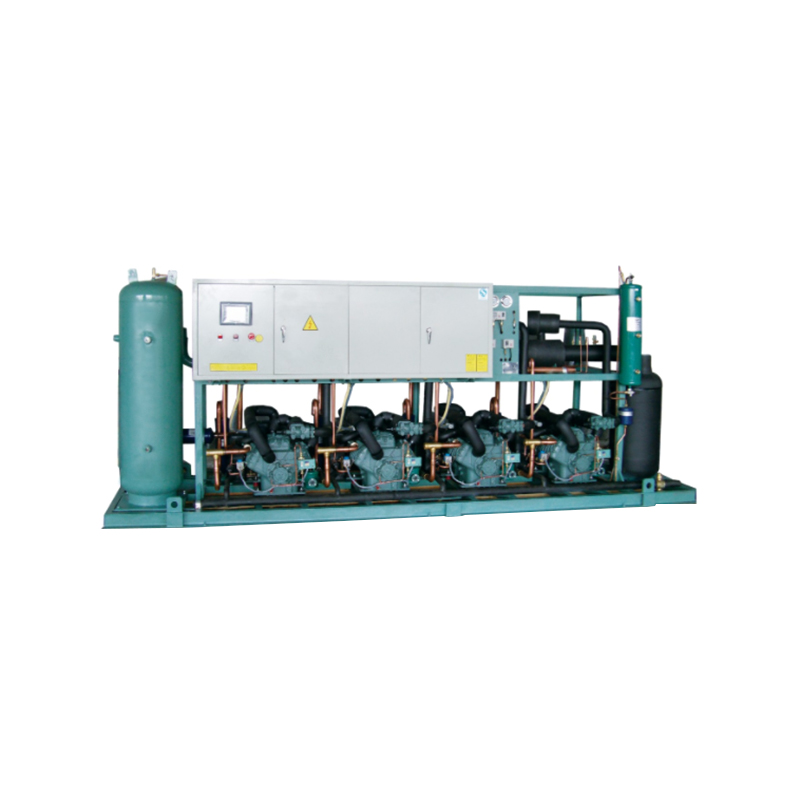
- Compatible with parallel unit configurations for large cold storage facilities requiring redundancy and phased capacity expansion
- Water-cooled and air-cooled configurations available to match site infrastructure
Side-by-Side Comparison for System Selection
| Specification | Scroll Compressor | Screw Compressor |
|---|---|---|
| Typical capacity range | 2 – 60 kW | 50 – 1,500 kW |
| Capacity control | On/off or variable speed | Stepless 25–100% |
| Noise and vibration | Very low | Low to moderate |
| Minimum evaporating temp | Approx. -40°C (low-temp variants) | Down to -50°C (low-temp screw) |
| Typical applications | Cold rooms, condensing units, air coolers, light commercial HVAC | Water chillers, large refrigeration storage, parallel units, industrial systems |
| Maintenance complexity | Lower — fewer moving parts | Moderate — rotor and bearing inspection required |
| Part-load efficiency | Good with variable speed drive | Excellent with stepless slide valve |
Matching Compressor Type to Cold Room and Refrigeration Storage Requirements
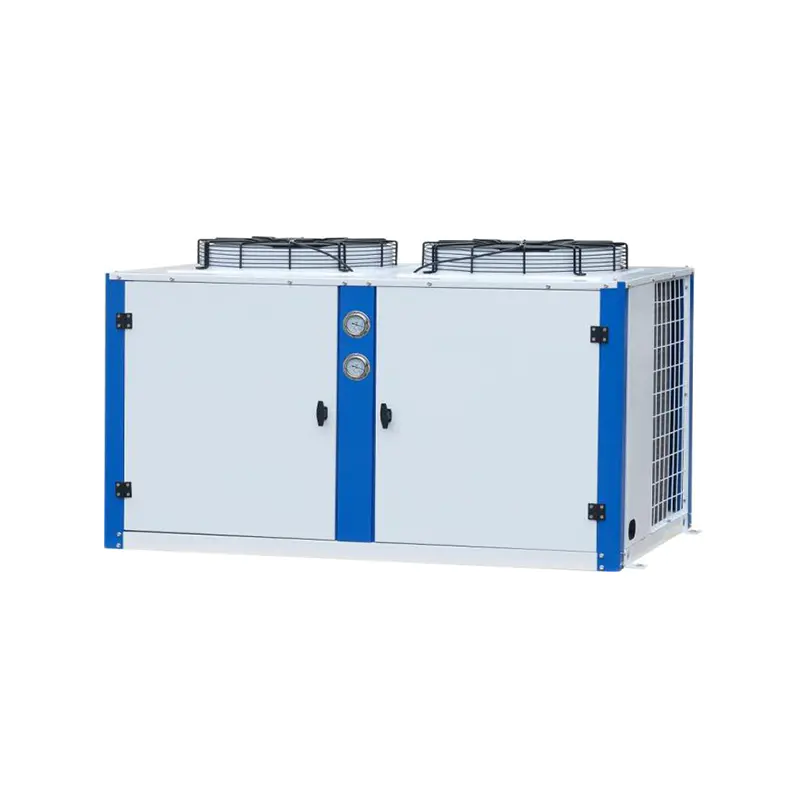
Cold rooms and refrigeration storage systems span a wide temperature range. Scroll compressors are the standard choice for medium-temperature applications — fresh produce, dairy, and beverage storage at 0 to +5°C, where evaporating temperatures typically fall between -10°C and -5°C. Their compact size integrates naturally into box condensing units and air-cooled condensing units used in these installations.
For blast-chill and deep-freeze refrigeration storage operating at -18°C to -25°C room temperature (evaporating temperatures of -30°C to -40°C), low-temperature screw compressors or parallel screw unit configurations are the appropriate solution. A single low-temperature screw unit handling 150–400 kW of refrigeration capacity can replace multiple smaller scroll units while delivering better part-load efficiency and simplified monitoring.
In large cold storage facilities running 24 hours a day, the energy difference between a correctly specified screw compressor and an oversized or undersized scroll system is substantial. A 10% improvement in COP across a 200 kW system running 7,000 hours per year represents 140,000 kWh saved — roughly $14,000 annually at a $0.10/kWh electricity rate.
Screw Compressors in Water Chiller Applications
Water chillers cool a secondary fluid — typically chilled water or glycol — rather than directly conditioning air. This indirect cooling arrangement introduces thermal mass, which smooths load fluctuations but also demands that the compressor respond accurately to changing demand over long operating periods.
Screw compressors address this requirement through their slide-valve capacity modulation mechanism, which adjusts output continuously without stopping and restarting the compressor. Most water chiller systems spend the majority of their operating hours between 40% and 70% of full design load, making part-load efficiency the dominant factor in annual energy consumption — not peak-load performance.
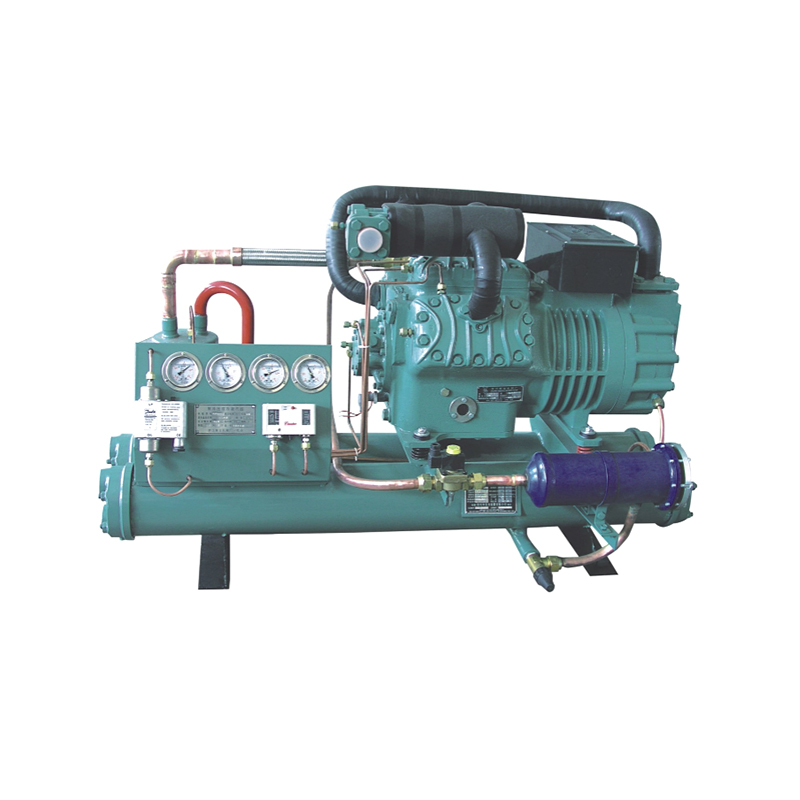
Water-cooled compression condensing units that pair a screw compressor with a water-cooled condenser consistently outperform air-cooled equivalents in COP terms, typically by 15–20% in moderate climates. This advantage compounds over thousands of operating hours in industrial water chiller applications.
Refrigeration Accessories That Support Compressor Performance
Both scroll and screw compressors depend on correctly specified refrigeration accessories to operate within their design parameters. Key components that interact directly with compressor health include:
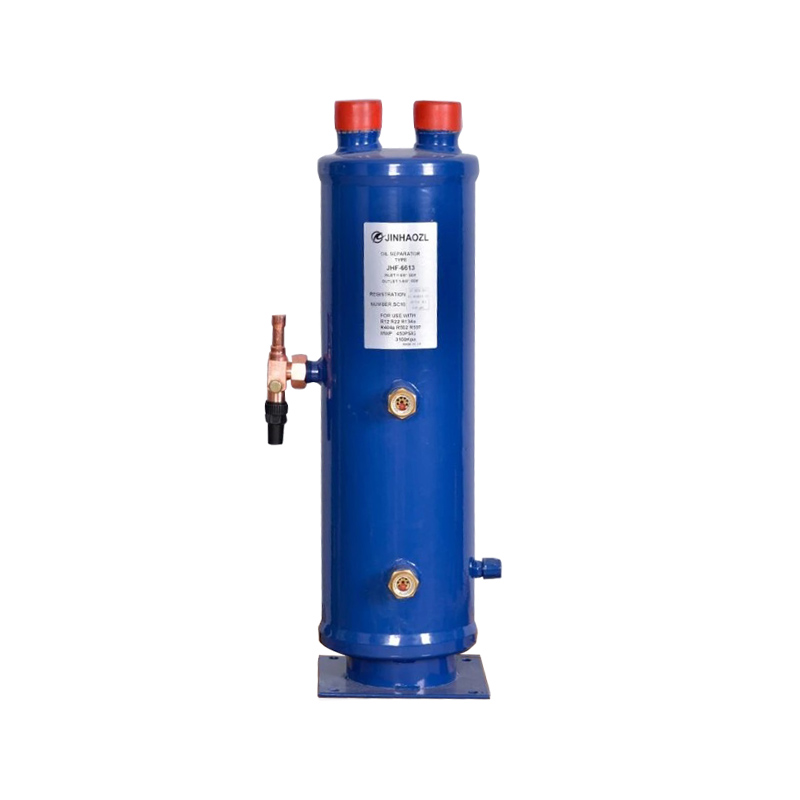
- Oil separators: capture lubricating oil entrained in the discharge gas before it enters the condenser or evaporator. In screw compressors, maintaining proper oil circulation is critical because the rotors require continuous lubrication for both sealing and cooling. A high-efficiency centrifugal oil separator reduces compressor power consumption by maintaining low pressure drop while ensuring thorough oil-gas separation.
- Filter-driers: remove moisture and particulates from the refrigerant circuit, protecting compressor valve seats and scroll surfaces from acid formation and abrasion damage.
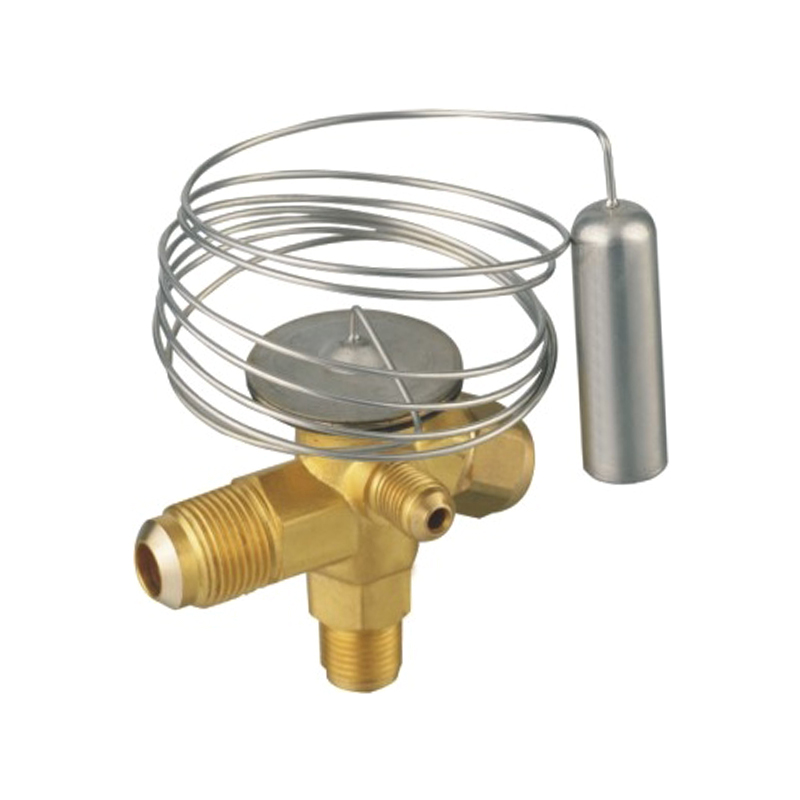
- Expansion valves: regulate refrigerant flow into the evaporator to maintain suction superheat within the compressor's specified range. Too little superheat risks liquid slugging; excessive superheat raises discharge temperature and shortens compressor life.
- Solenoid valves: enable rapid circuit isolation and pump-down sequences that prevent liquid refrigerant from migrating to the compressor during off cycles.
Why Source Scroll and Screw Compressors from a Chinese Manufacturer
China's refrigeration manufacturing sector produces scroll and screw compressors across a broad capacity range, supplying markets in over 80 countries. A Chinese manufacturer with an in-house R&D team and foundry can provide OEM and ODM configurations — adapting compressor assemblies, condensing unit housings, and refrigeration accessories to non-standard project specifications at costs typically 20–40% below equivalent European-branded equipment.
For buyers evaluating a Chinese HVAC refrigeration supplier, the most important verification steps are confirming that certification coverage matches the specific model and refrigerant being ordered, reviewing actual factory test data rather than rated specification sheets, and establishing that spare parts and technical support are accessible in the destination market. Suppliers with documented export histories to multiple regions have already resolved the compliance and logistics challenges that create delays when working with less experienced manufacturers.