 English
 русский
 Tiếng Việt
Content
- 1 How Differences in Working Principles and Structure Define Performance Boundaries
- 2 Energy Efficiency Performance: Differentiated Competition at Full and Part Load
- 3 Maintenance Costs and Serviceability: Key Variables for Long-Term Operations
- 4 Applicable Scenarios and Selection Decision Matrix
- 5 Why New Refrigerant Compatibility Is Reshaping Both Technology Paths
- 6 Which Practical Framework Should Guide Your Selection Decision
In the refrigeration compressor sector, reciprocating and screw compressors represent the two dominant technology paths. The direct answer to the selection question is: choose reciprocating compressors for applications under 50kW, intermittent operation, and budget-sensitive scenarios; choose screw compressors for applications above 100kW, continuous operation exceeding 4,000 hours per year, and where energy efficiency and stability are critical. The two are not simple substitutes but complement each other across different operating ranges. In the 2025 global refrigeration compressor market, reciprocating compressors account for approximately 38%, screw compressors for about 31%, with the remainder comprising scroll, centrifugal, and other types. This landscape is expected to remain stable over the next five years.
How Differences in Working Principles and Structure Define Performance Boundaries
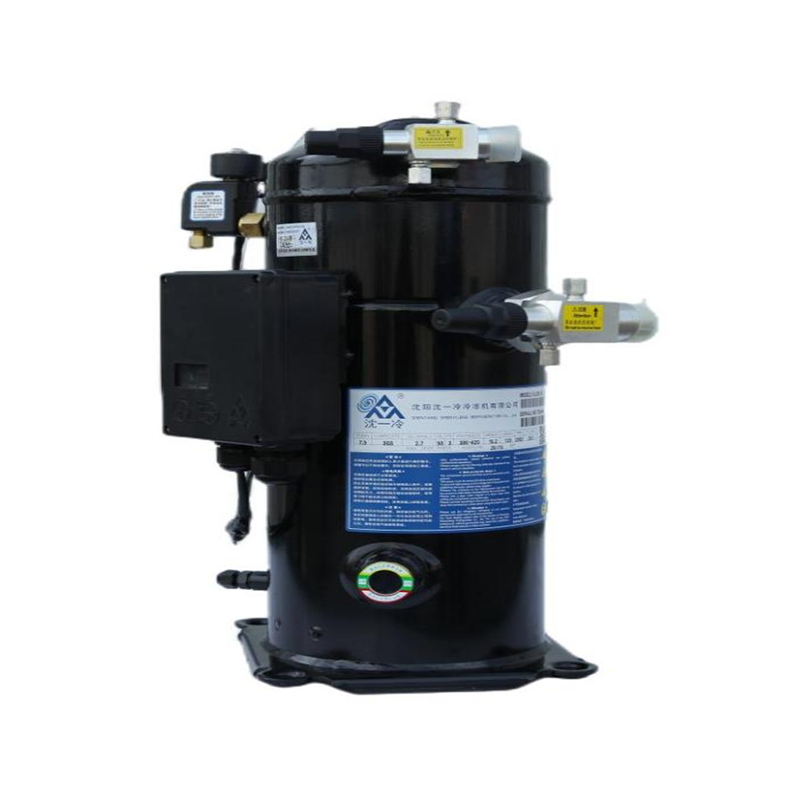
Reciprocating compressors drive pistons within cylinders via a crankshaft to complete intake, compression, and discharge strokes. Their simple structure and high degree of parts standardization deliver single-unit cooling capacities typically ranging from 1kW to 150kW. Screw compressors, by contrast, rely on a pair of meshing male and female rotors turning within a housing to achieve gas compression through volume changes between the screw threads. Their more precise construction typically starts at 30kW per unit, with upper limits exceeding 1,500kW.
Core Structural Comparison
<<| Comparison Dimension | Reciprocating Compressor | Screw Compressor |
|---|---|---|
| Compression Method | Reciprocating positive displacement | Rotary positive displacement |
| Number of Moving Parts | Higher (piston, connecting rod, crankshaft, valve assembly) | Lower (male/female rotors, bearings, slide valve) |
| Single-Unit Cooling Capacity Range | 1kW – 150kW | 30kW – 1,500kW+ |
| Speed Range | Typically 1,000 – 1,500 rpm | Typically 2,000 – 4,500 rpm |
| Vibration and Noise Level | Higher (due to reciprocating inertia forces) | Lower (smooth rotary motion) |
| Typical Service Life | 15,000 – 25,000 hours | 40,000 – 60,000 hours |
| Major Overhaul Interval | Every 8,000 – 12,000 hours | Every 20,000 – 30,000 hours |
From a structural perspective, the valve assembly (suction and discharge valve plates) of reciprocating compressors is a wear-prone component. Under high-frequency start-stop conditions, valve plate fatigue fracture represents the primary failure mode, accounting for over 35% of reciprocating compressor failures. Screw compressors have no valve structure; their reliability bottleneck lies in rotor meshing clearance control and bearing life. High-end screw compressors use five-axis CNC grinding machines to machine rotor profiles, controlling meshing clearance within 0.03mm, paired with ceramic hybrid bearings to maintain mechanical efficiency above 85%.
Energy Efficiency Performance: Differentiated Competition at Full and Part Load
Energy efficiency is one of the core metrics for compressor selection, but reciprocating and screw compressors exhibit significant differences across different load ranges. At full load, modern semi-hermetic reciprocating compressors typically achieve a Coefficient of Performance (COP) between 2.8 and 3.2, while oil-injected screw compressors can reach 3.0 to 3.5. The gap appears modest, but in actual operation, refrigeration systems spend over 70% of their time at part load, where the efficiency curves of the two diverge markedly.
Part-Load Energy Efficiency Comparison Data
Taking a 100kW cold storage system as an example, measured energy efficiency data at 50% load ratio is as follows:
- Reciprocating compressor: COP degrades to 75% – 80% of full-load value, due to clearance volume reducing volumetric efficiency, with no capability to unload individual cylinders
- Screw compressor: Through slide valve stepless regulation, COP maintains 90% – 95% of full-load value, demonstrating clear part-load efficiency advantages
This means that in continuous refrigeration scenarios with annual operating time exceeding 4,000 hours, screw compressors—despite higher initial investment—can reduce total lifecycle energy costs by 18% – 25% compared to reciprocating compressors, thanks to their part-load efficiency advantage. For intermittent applications with annual operating time below 2,000 hours (such as small cold storage units or commercial display coolers), the lower initial investment and acceptable efficiency degradation of reciprocating compressors offer greater economic rationality.
Maintenance Costs and Serviceability: Key Variables for Long-Term Operations
Maintenance costs directly impact a compressor's Total Cost of Ownership (TCO). The advantage of reciprocating compressors lies in their modular design and universal parts—wear components such as valve assemblies, piston rings, and connecting rod bearings can be replaced on-site quickly without factory return. A standard overhaul (replacing valves, piston rings, and bearings) typically requires 8 – 12 hours of labor, with parts costs accounting for 60% – 70% of total overhaul costs.
Screw compressor maintenance exhibits a low-frequency, high-per-event characteristic. Their major overhaul interval is 2.5 to 3 times longer than reciprocating compressors, but each overhaul involves precision procedures such as rotor profile restoration, bearing replacement, and clearance readjustment, typically requiring factory return or specialized tooling. Overhaul labor usually requires 24 – 48 hours, and demands higher technical expertise. However, routine screw compressor maintenance only requires periodic lubricant and oil filter changes, reducing annual routine maintenance labor by approximately 40% compared to reciprocating compressors.
Ten-Year Maintenance Cost Estimate Comparison
<<| Cost Item | Reciprocating Compressor | Screw Compressor |
|---|---|---|
| Routine Maintenance (Lubricant, Filters) | Higher (oil change interval 2,000 hours) | Moderate (oil change interval 8,000 hours) |
| Wear Parts Replacement (Valves/Piston Rings vs Bearings/Seals) | Every 8,000 hours, high frequency | Every 25,000 hours, low frequency |
| Major Overhauls (Within Ten Years) | 4 – 5 times | 1 – 2 times |
| Single Overhaul Downtime | 8 – 12 hours (can be done on-site) | 24 – 48 hours (often requires factory return) |
| Ten-Year Total Maintenance Cost Ratio (Relative to Initial Investment) | 80% – 120% | 40% – 60% |
As shown in the table, screw compressors demonstrate significantly lower total maintenance costs over a ten-year cycle, but this advantage only materializes under high operating hours. For scenarios with annual operation below 1,500 hours, the lower maintenance frequency of reciprocating compressors actually offers greater flexibility.
Applicable Scenarios and Selection Decision Matrix
Final selection should return to specific application scenarios. The following decision matrix provides engineering practice reference based on four dimensions: cooling capacity, operating hours, ambient temperature, and budget constraints:
Optimal Application Scenarios for Reciprocating Compressors
- Small-scale commercial refrigeration: Convenience store coolers, small cold storage units (cooling capacity < 50kW), where equipment investment payback period is sensitive
- Intermittent operation systems: Daily operation time < 8 hours, frequent start-stop cycles, where the quick-start characteristics of reciprocating compressors are advantageous
- Remote areas or limited maintenance resources: Strong on-site serviceability, universal parts readily available
- Ultra-low temperature conditions (evaporation temperature < -40°C): Single-stage reciprocating compressor technology is mature in ultra-low temperature applications; screw compressors require economizers or two-stage compression
Optimal Application Scenarios for Screw Compressors
- Medium-to-large industrial refrigeration: Food processing, cold chain logistics warehousing (cooling capacity > 100kW), with high continuous operation requirements
- Annual operating time exceeding 4,000 hours: Part-load efficiency advantages translate into significant electricity cost savings
- Strict noise and vibration limitations: Screw compressors typically operate 8 – 12 dB(A) quieter than equivalent reciprocating compressors
- Refrigerant transition requirements: Screw compressors demonstrate better adaptability to A2L refrigerants such as R290 and R454B, as the absence of valve structures eliminates leak risk points at valves for flammable refrigerants
Why New Refrigerant Compatibility Is Reshaping Both Technology Paths
As low-GWP refrigerants such as R290, R454B, and R1234yf become widespread, compressor design logic is undergoing fundamental changes. The core challenge for reciprocating compressors lies in valve material compatibility with flammable refrigerants—traditional valve plate materials (such as spring steel) face hydrogen embrittlement risks in A2L refrigerant environments, requiring replacement with stainless steel or special alloys, while valve seat sealing surfaces must be redesigned to reduce micro-leakage. Industry testing shows that reciprocating compressor valve assemblies adapted for R290 experience fatigue life reductions of approximately 15% – 20% compared to R404A operating conditions.
Screw compressors possess structural advantages in new refrigerant adaptation. Without valves, their leak paths are limited to shaft seals and housing joints. By adopting double mechanical seals and positive-pressure explosion-proof enclosures, screw compressors can control R290 leak rates below 3g/year, meeting IEC 60335-2-89 safety requirements for A2L refrigerants. Furthermore, the screw compressor's adjustable built-in volume ratio design (via slide valve regulation) provides greater flexibility when addressing different refrigerant property changes—the adiabatic index of R290 (1.13) differs significantly from R404A (1.09), yet screw compressors can limit isentropic efficiency fluctuation within ±3% by adjusting the volume ratio, whereas reciprocating compressors require cylinder head replacement or clearance volume adjustment.
Which Practical Framework Should Guide Your Selection Decision
Based on the comprehensive analysis above, refrigeration compressor selection can follow this three-step decision framework:
- Step 1: Determine cooling capacity and operating hour thresholds. For cooling capacity <50kW and annual operation <2,000 hours, prioritize reciprocating; for cooling capacity >100kW and annual operation >4,000 hours, prioritize screw. The 50kW – 100kW range requires Life Cycle Cost (LCC) calculation
- Step 2: Evaluate refrigerant compatibility requirements. If the system plans to use R290 or R454B, screw compressors offer higher safety margins; for traditional HFC or HFO refrigerants, the gap narrows
- Step 3: Calculate maintenance resources and downtime costs. If on-site professional maintenance staff are lacking or downtime costs are extremely high (such as in pharmaceutical cold chain), the long maintenance intervals of screw compressors are more attractive; if maintenance flexibility and parts universality are priorities, reciprocating compressors remain the pragmatic choice
Industry data shows that enterprises adopting systematic selection processes can reduce the five-year total cost of ownership of their refrigeration compressor systems by 15% – 22% compared to random selection, with unplanned equipment downtime reduced by over 35%. As refrigeration compressor technology continues to evolve, data-driven selection decisions are shifting from "experience-based judgment" to "engineering calculation"—an essential path to improving overall system reliability and economic performance.