 English
 русский
 Tiếng Việt
Content
- 1 Start With the Crop and Its Storage Envelope
- 2 Calculate the Refrigeration Load in the Right Order
- 3 Size the Envelope: Panels, Floors, and Doors
- 4 Airflow and Humidity Decide Shelf Life
- 5 Build the Refrigeration System as One Package
- 6 Plan Heat Rejection Before You Pour the Floor
- 7 Commission With Data, Then Recheck Every Season
- 8 Frequently Asked Questions
A cold room can display a steady 2 °C and 92% relative humidity and still cost you a week of shelf life. The setpoint is the last five percent of the design. What actually protects produce is the order of the decisions made before anyone chooses a compressor: which crops the room must hold, how much heat has to be removed and how fast, how well the envelope resists heat and vapor, how gently the cooler dries the air, and how the system behaves on the hottest afternoon of the year.
The short version: design for pull-down rather than holding, never mix crops that cannot share one atmosphere, keep the evaporator as warm as the load allows, and commission the room with a temperature map instead of a single thermometer. Each section below explains one decision with the numbers, tolerances, and mistakes that show up on real projects.
Start With the Crop and Its Storage Envelope
Conclusion first: build the room around a crop list, not around a floor plan. One large room is often the most expensive answer, because temperature and humidity needs differ so much between commodities that one group always suffers.
Temperature is the number everyone remembers; humidity is the one that decides whether you sell weight or lose it. Most fruits and vegetables hold best between 90% and 95% relative humidity, but dry onions and garlic want 65-70%, and putting them in the same room as leafy greens guarantees that one of the two is wrong. Ethylene is the second trap: apples, bananas, and tomatoes release it, while leafy greens, cucumbers, and carrots react to it by yellowing, spotting, or turning bitter.
| Commodity | Storage temperature | Relative humidity | Typical life | Design note |
|---|---|---|---|---|
| Apples | -1 to 1 °C | 90-95% | 6-12 months | Strong ethylene producer |
| Strawberries | 0-2 °C | 90-95% | 5-7 days | Pre-cool within two hours |
| Leafy greens | 0-2 °C | 95-98% | 10-14 days | Very ethylene sensitive |
| Citrus | 4-8 °C | 85-90% | 4-8 weeks | Chilling injury below 3 °C for some varieties |
| Potatoes | 4-7 °C | 90-95% | 4-9 months | Keep dark to prevent greening |
| Tomatoes | 10-13 °C | 85-90% | 1-2 weeks | Ripen at 18-22 °C, not in store |
| Bananas | 13-15 °C | 90-95% | 2-4 weeks | Chilling injury below 12 °C |
| Dry onions | 0-4 °C | 65-70% | 6-9 months | Low humidity is deliberate |
| Avocado | 5-13 °C | 85-90% | 2-4 weeks | Setpoint varies by variety |
The bars show the same temperature ranges as the table (bar colors simply alternate for readability). If the crop list contains two groups whose setpoints sit more than 4 °C apart, plan two rooms. The extra wall and door normally cost less than one damaged harvest.
Calculate the Refrigeration Load in the Right Order
Conclusion: size the plant for the pull-down load at the design ambient, not for the steady-state holding load. In a fresh produce room, the holding load is usually only 15-25% of the peak.
A 50-tonne apple room is a useful example. Product arrives at 20 °C and must be down to roughly 1-2 °C within 24 hours. Product heat is 50,000 kg x 3.6 kJ/kg/K x 19 K divided by 86,400 s, which is about 40 kW. Respiration adds roughly 1 kW, transmission through 100 mm panels about 2 kW on a hot afternoon, evaporator fans and defrost about 5 kW, door openings about 5 kW, and people and lighting about 2 kW. The realistic design point lands near 55 kW.
- Field heat 40 kW
- Fans and defrost 5 kW
- Door infiltration 5 kW
- Transmission 2 kW
- Respiration 1 kW
- People and lights 2 kW
A room sized on the holding load alone, roughly 10 kW, would have only about one fifth of the required capacity. The compressor would run continuously, the crop would never pull down, and the failure would appear as soft fruit rather than as an alarm.
- Cooling speed is a quality decision. Seven-eighths cooling takes about three times the half-cooling time, so a pallet with a 6-hour half-cooling time needs roughly 18 hours to come within 12.5% of the final temperature.
- Pre-cooling inside the storage room forces you to size everything for the busiest day of the season. A separate pre-cooling bay is often cheaper than oversizing the main plant, and it keeps the store stable while new harvest arrives.
Size the Envelope: Panels, Floors, and Doors
Conclusion: for a room held between 0 °C and 10 °C, 80-100 mm PIR panels are enough. Thinner panels save a little capital and add compressor hours for the next fifteen years.
A 100 mm PIR panel has a U-value of about 0.22 W/m2/K. Across a 200 m2 envelope and a 25 K difference, that is roughly 1.1 kW of transmission load, and closer to 2 kW on a hot afternoon with sun on the walls. It looks small next to a 40 kW product load, but it runs every hour of every day, and it is the part of the load you can reduce permanently with a better wall.
Vapor control matters more than thickness. Keep the vapor barrier on the warm side, seal the panel joints, and foam every pipe and cable penetration. A 5 mm gap leaks more moisture than the panel leaks heat, and the result is ice at the joint, a swollen floor, and a door that no longer closes.
- Floor: insulation under the slab, an anti-slip finish, and a slope of about 1:100 toward a trapped drain. A dry trap lets warm, moist air creep under the panels.
- Doors: 1.2-1.5 m sliding or double-leaf doors for medium-temperature rooms, with strip curtains where traffic is heavy. Never place the door directly in front of the evaporator.
- Air paths: keep 300-500 mm clear below the cooler and at the return, use 3.0-3.5 m aisles for forklifts, and stack cartons with gaps that line up with the airflow.
Airflow and Humidity Decide Shelf Life
Conclusion: run the evaporator as warm as the load allows. The difference between room air and evaporating temperature, the TD, sets how dry the coil surface is, and the coil surface sets the room humidity.
A +4 °C room served by a cooler running at -8 °C works with a 12 K TD. Air touching that coil is cooled far below its dew point, moisture condenses on the fins, and relative humidity settles near 70-75% instead of the 90-95% the crop needs. Choose a cooler with wide fin spacing, typically 4.5-6 mm for fresh produce, so the coil acts as a cooling surface rather than a dehumidifier.
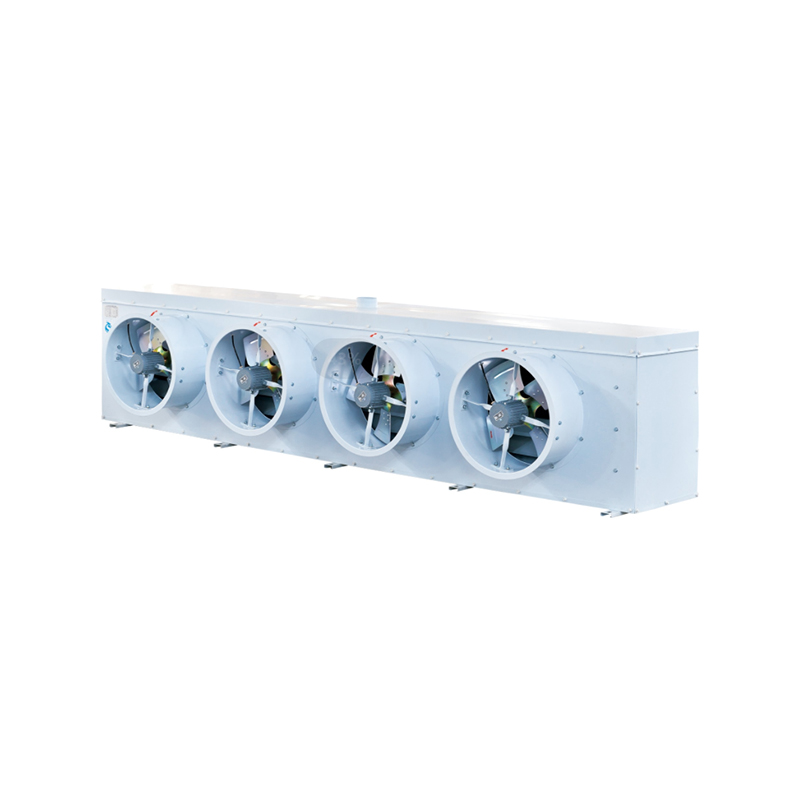 DD type medium-temerature evaporatorDD-type evaporator is mainly suitable for cold storage at -18°C. Can store frozen foods such as meat and fish at low temperatures.View Product →
Air movement should be gentle in a storage room and fast only in a pre-cooling room. Long-term storage works best at about 0.05-0.1 m/s through the stack, while forced-air pre-cooling needs 0.5-2 m/s. In both cases, air has to travel through the load, not around it.
Defrost control is the most common source of humidity swings. Use off-cycle or on-demand defrost with coil-temperature termination instead of a fixed clock. Every unnecessary defrost adds heat and water to the room, and every missed one blocks the coil with frost.
Build the Refrigeration System as One Package
Conclusion: select compressor, condenser, and cooler together by evaporating and condensing temperature. Nominal horsepower is a label; capacity at your duty point is the engineering.
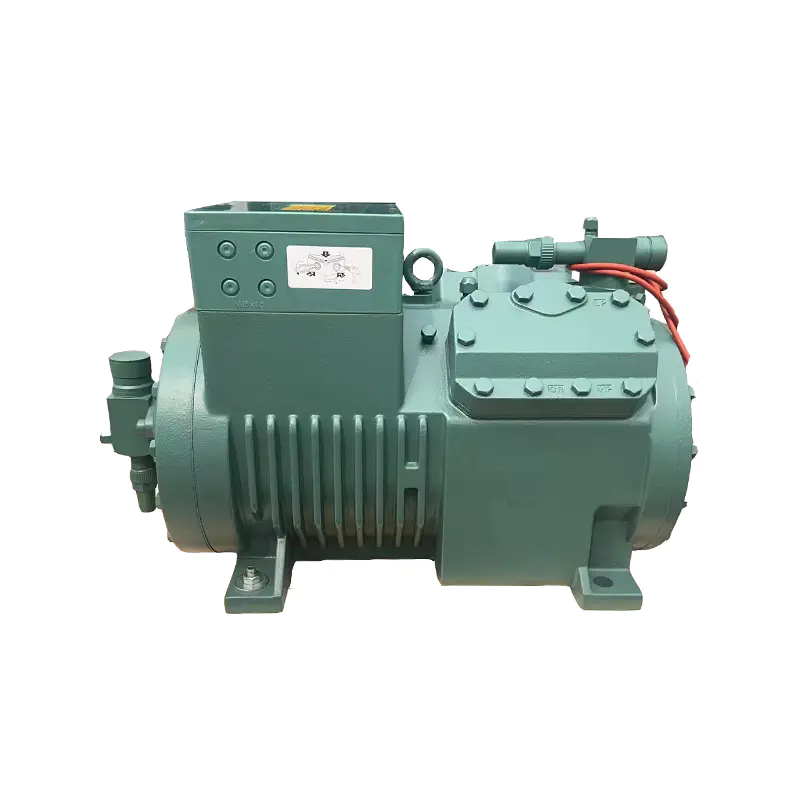
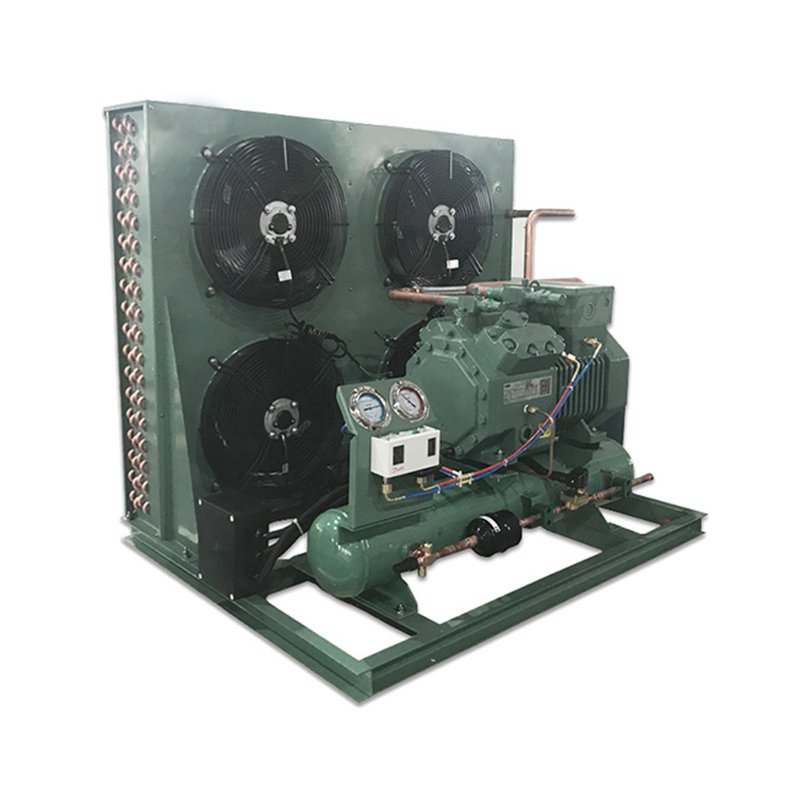
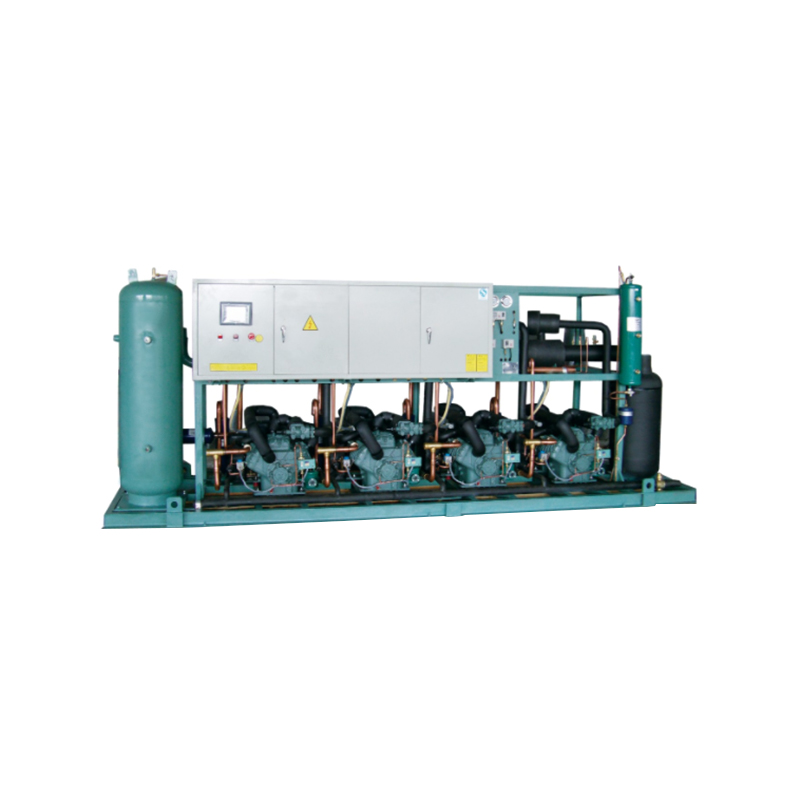
For small and medium rooms, an air-cooled condensing unit with a scroll or semi-hermetic reciprocating compressor covers most fruit and vegetable applications. Larger projects usually justify parallel racks, water-cooled condensers, or screw compressors, where part-load efficiency and refrigerant charge matter more than first cost.
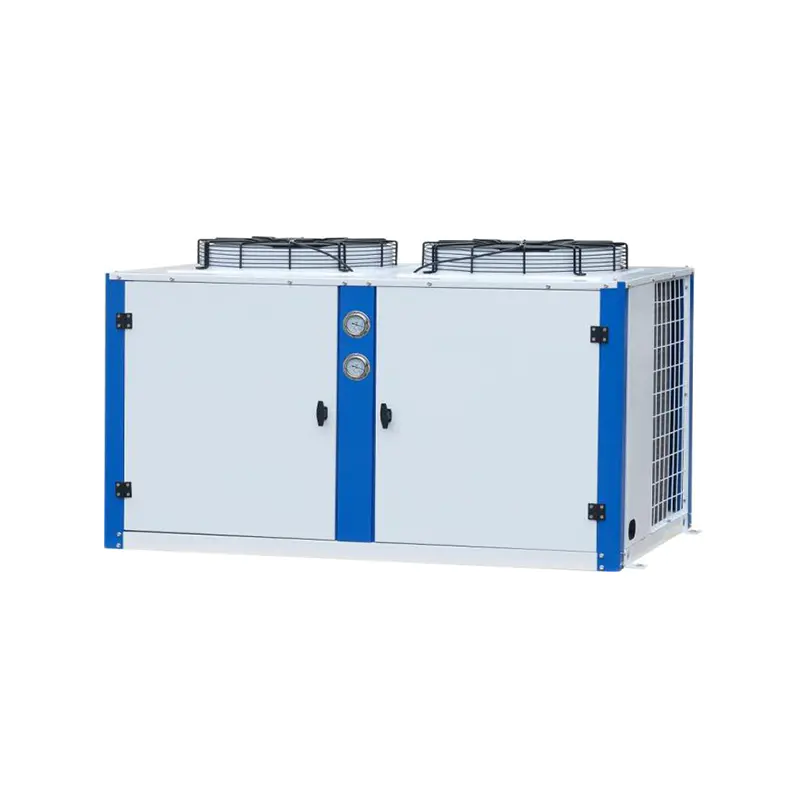
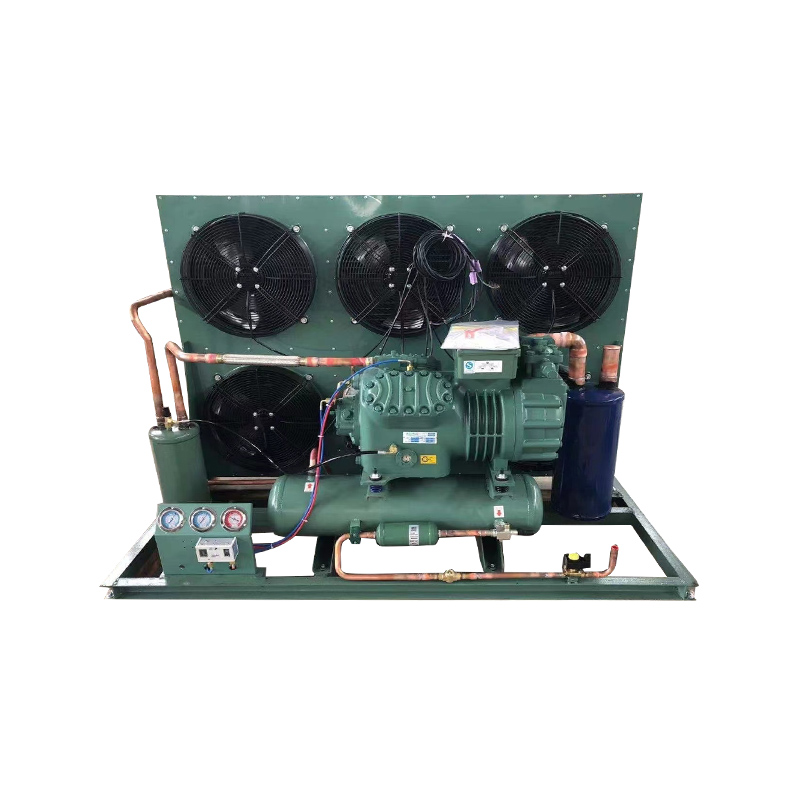 Air-cooled condensing unitAir-cooled unit is a device that achieves cooling by dissipating heat through air. It includes compressors, condensers, evaporators, throttling components and control ...View Product →
Match the cooler to the temperature band: high-temperature units for ripening and staging rooms, medium-temperature units for the 0-10 °C produce room, and low-temperature units only where frozen product shares the building. Refrigerant choice follows the same logic. R448A, R449A, and R507A remain common for medium and low temperature systems; propane is efficient in small hermetic units but needs a charge limit and ventilation; ammonia and CO2 suit large plants where leak detection and trained staff are already available.
Working with a manufacturer of semi-hermetic compressors that also builds condensers and coolers keeps capacity figures consistent at one duty point, instead of leaving three catalogues to disagree on the same afternoon.
Plan Heat Rejection Before You Pour the Floor
Conclusion: decide where the rejected heat goes before the layout is fixed, because it constrains both the site and the budget.
Air-cooled condensers are the default for small and medium rooms. They need free space, about 1-1.5 m around and above the coil, no recirculation between units, and a position where dust, leaves, and warm exhaust do not return to the inlet. On a 38-40 °C design day, an air-cooled system can lose 10-15% of the capacity it showed at a 32 °C rating point, so either oversize the condenser or accept a higher condensing temperature and a lower coefficient of performance.
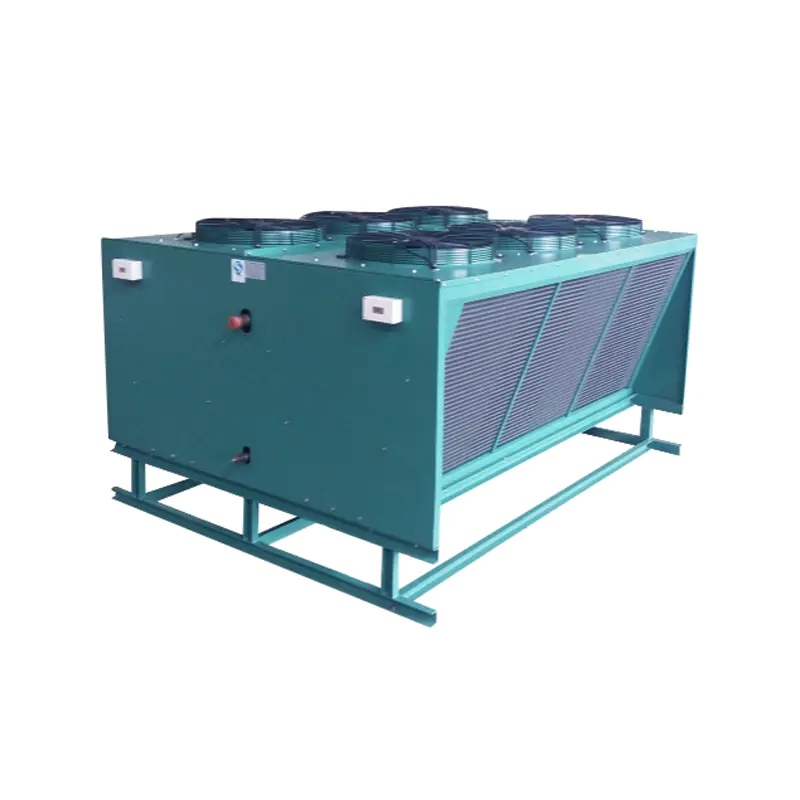 V Type Air Cooled CondenserV stands for V-type apical air outlet.The shell is made of high-quality steel plate, and the surface is phosphated and spray-coated to resist corrosion.View Product →
Water-cooled condensers with a cooling tower or closed-circuit cooler solve high ambient and noise problems, but they add water treatment, freeze protection, and maintenance. Choose them when the ambient is genuinely severe or when the condenser must sit close to a boundary with a noise limit.
Commission With Data, Then Recheck Every Season
Conclusion: a cold room is accepted with a temperature map and a pull-down curve, not with a thermometer held near the door.
The curve above shows the classic pattern: room air reaches setpoint within hours, while the product core takes most of a day. If the two lines stop converging, the plant is short of capacity or the airflow is blocked.
- Map nine points, including two corners near the door, and confirm the spread stays within 1 °C after 24 hours with a full load.
- Record a pull-down curve with a core probe on one pallet and keep it as the baseline for future seasons.
- Check superheat and subcooling at the design ambient, verify defrost termination, confirm the drain runs free, and set alarms on temperature, door-open time, and power failure.
When performance drifts, work through symptoms instead of guessing; a structured fault analysis for cold storage refrigeration systems saves far more product than replacing parts at random.
Frequently Asked Questions
What panel thickness does a fruit and vegetable cold room need?
For rooms held between 0 °C and 10 °C, 80-100 mm PIR panels cover most projects. Thicker panels earn their cost when the room adjoins a hot roof or a sunlit wall, or when the temperature difference exceeds 25 K.
Not safely. Apples release ethylene, and leafy greens, cucumbers, and carrots respond to it with yellowing and faster decay. Their humidity demands also differ, so two smaller rooms with separate units normally pay for themselves within a season.
Do I need a separate pre-cooling room?
For more than a few tonnes a day, yes. Field heat is the largest single load, and removing it in a dedicated bay keeps the storage room stable instead of forcing the main plant to run at peak for a few hours every day.
Designing a cold room for fruits and vegetables is mostly a matter of order: fix the crop list, then the load, then the envelope, then the cooler, and only then the equipment. Each step depends on the one before it, and a room that skips the load calculation cannot be repaired with a better controller.