 English
 русский
 Tiếng Việt
Content
- 1 Classification and Applicable Temperature Ranges of D-Series Air Coolers
- 2 Key Technical Parameter Comparison
- 3 Evaporator Structure and Working Principle
- 4 Selection Calculation and Heat Load Assessment
- 5 Defrosting Strategies and Energy Efficiency Management
- 6 Installation and Maintenance Essentials
- 7 Emerging Evaporator Technology Trends
In industrial refrigeration systems, evaporator (air cooler) selection directly determines the energy consumption level of cold storage and the quality stability of stored goods. The DL type is suitable for fresh-keeping storage above 0°C, the DD type for cold storage at -18°C, and the DJ type for quick-freezing storage below -25°C. The core differences among the three models lie in fin spacing, cooling capacity, and defrosting methods. Mismatched selection will lead to frost blockage, surging energy consumption, or product spoilage. Selection must comprehensively consider storage temperature, product characteristics, and heat load rather than relying solely on experience.
Classification and Applicable Temperature Ranges of D-Series Air Coolers
D-series air coolers commonly used in industrial cold storage are divided into three models based on applicable temperature, each corresponding to different refrigeration requirements and storage temperature environments:
- DL Type High-Temperature Evaporator: Applicable for storage temperatures above 0°C, mainly used for fresh-keeping storage of fruits, vegetables, fresh eggs, tea, and large workshop air conditioning systems.
- DD Type Medium-Temperature Evaporator: Applicable for storage temperatures from -1°C to -18°C, suitable for cold storage of meat, fish, ice cream, and other frozen foods.
- DJ Type Low-Temperature Evaporator: Applicable for storage temperatures below -18°C, mainly used for quick-freezing storage of fresh meat, fish, dumplings, and other foods, with storage temperatures typically below -25°C.
The core structural differences among the three models are reflected in fin spacing and airflow design. Under low-temperature conditions, moisture in the air condenses and frosts on the evaporator surface more rapidly, so the DJ type adopts larger fin spacing (typically 6mm to 9mm), while the DL type has smaller fin spacing (approximately 4mm to 5mm) to maximize heat exchange area in relatively high-temperature environments.
Key Technical Parameter Comparison
| Parameter | DL Type (High-Temp) | DD Type (Medium-Temp) | DJ Type (Low-Temp) |
|---|---|---|---|
| Applicable Storage Temp | 0°C ~ +10°C | -1°C ~ -18°C | -18°C ~ -35°C |
| Fin Spacing | 4.0 ~ 4.5 mm | 4.5 ~ 6.0 mm | 6.0 ~ 9.0 mm |
| Design Temperature Difference (DTD) | 8°C ~ 10°C | 7°C ~ 9°C | 5°C ~ 7°C |
| Defrosting Method | Natural Defrost or Electric Heating | Electric Defrost / Water Spray | Electric Defrost / Hot Gas Defrost |
| Applicable Refrigerants | R22 / R404A / R507 | R22 / R404A / R507 | R22 / R404A / R507 / NH₃ |
| Typical Applications | Fresh Storage, Workshop AC | Cold Storage, Cold Chain Logistics | Quick-Freezing Storage, Blast Freezers |
As shown in the table above, as storage temperature decreases, fin spacing must increase accordingly to prevent frost layers from blocking air passages. The design temperature difference (DTD) of DJ type low-temperature evaporators is typically controlled at 5°C to 7°C, lower than the 8°C to 10°C of DL type, to maintain higher relative humidity during quick-freezing processes and reduce food dehydration loss.
Evaporator Structure and Working Principle
Core Component Composition
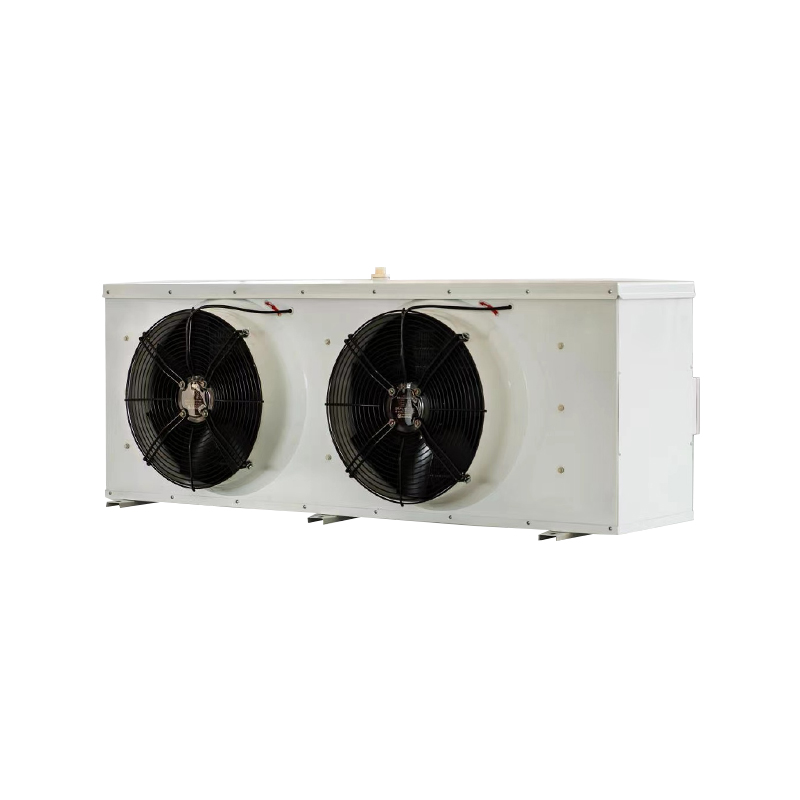
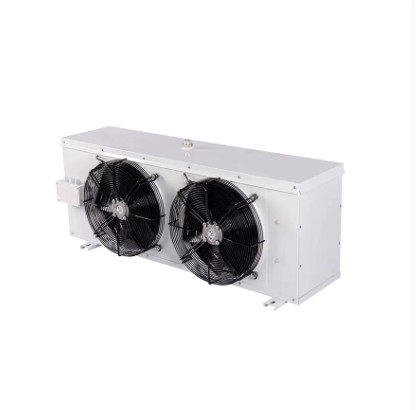
Industrial air coolers mainly consist of five components: cooling heat exchange coils, axial fans, liquid distributors, defrosting devices, and drain pans. Low-temperature, low-pressure saturated refrigerant enters the evaporator through a thermostatic expansion valve, evaporating and absorbing heat within the heat exchange tubes. The fan forces air to flow across the fin surfaces, removing heat from the cold storage to achieve cooling.
Factors Affecting Heat Exchange Efficiency
The actual cooling effect of an evaporator is constrained by multiple factors:
- Air Velocity and Volume: Insufficient air velocity leads to inadequate heat exchange, while excessive velocity increases fan energy consumption and may dehydrate food surfaces. In industrial quick-freezing storage, air velocity is typically designed at 3m/s to 5m/s.
- Fin Cleanliness: Dust and oil accumulation can reduce the heat transfer coefficient by 15% to 30%; regular cleaning is essential to maintain energy efficiency.
- Frost Layer Thickness: When frost thickness exceeds 3mm, air-side thermal resistance increases significantly, potentially reducing cooling capacity by more than 20%; timely defrosting is mandatory.
- Liquid Supply Superheat: Proper superheat (typically 3°C to 8°C) prevents compressor liquid slugging while ensuring effective utilization of the evaporator's heat exchange area.
Selection Calculation and Heat Load Assessment
Evaporator selection cannot rely solely on experience; heat load calculations are mandatory. The total heat load of a cold storage consists of the following components:
- Enclosure Heat Load: Heat transferred through walls, roofs, and floors, proportional to insulation thickness and temperature difference.
- Product Heat Load: Heat released during product cooling or freezing, which can account for over 60% of the total in quick-freezing storage.
- Ventilation Heat Load: Heat brought in by external warm air when cold storage doors are opened or during ventilation.
- Motor and Lighting Heat Load: Heat generated by fan motors and lighting fixtures during operation.
- Personnel Operation Heat Load: Heat emitted by workers during operations inside the storage.
Selection should include a 10% to 15% safety margin based on the calculated total heat load to account for extreme weather or fluctuations in product turnover. Additionally, the nominal cooling capacity of the evaporator must be corrected based on actual operating conditions (storage temperature, evaporating temperature, condensing temperature), using manufacturer-provided performance curves as the correction basis.
Defrosting Strategies and Energy Efficiency Management
Comparison of Common Defrosting Methods
| Defrosting Method | Principle | Applicable Scenarios | Energy Characteristics |
|---|---|---|---|
| Electric Defrost | Electric heating tubes heat fins | Small to medium cold storage | Higher energy consumption, simple structure |
| Water Spray Defrost | Ambient temperature water spray | Medium to large cold storage | High water consumption, fast defrosting |
| Hot Gas Defrost | Compressor discharge heat | Large quick-freezing storage, ammonia systems | Optimal energy efficiency, complex system |
Defrosting Cycle Setting Recommendations
Defrosting frequency should be dynamically adjusted based on door opening frequency, product moisture content, and evaporator frosting speed. For quick-freezing storage below -25°C, hot gas defrosting is recommended every 4 to 6 hours, with each defrosting cycle controlled within 15 to 20 minutes. Frequent defrosting causes storage temperature fluctuations affecting food quality; excessively long intervals lead to frost buildup, increased air resistance, and rising fan power consumption.
Installation and Maintenance Essentials
Proper installation and regular maintenance are essential for long-term efficient evaporator operation:
- Installation Position: Air coolers should be installed at the top or high on side walls of the cold storage, with air outlets facing the door direction to create uniform airflow distribution and avoid direct cold air blowing on products.
- Level Calibration: The unit must be installed horizontally; tilting will cause poor defrost water drainage, leading to water accumulation or overflow in the drain pan.
- Return Air Clearance: At least 300mm of return air space should be maintained between the evaporator and walls or product stacks to ensure unobstructed air circulation.
- Regular Cleaning: Clean fins quarterly with soft brushes or low-pressure water jets to remove dust and oil; inspect fan blades for deformation and motor bearings for lubrication.
- Leak Detection and Insulation: Conduct annual airtightness checks on refrigeration piping; ensure insulation layers on liquid supply and suction lines remain intact to prevent cold loss and condensation.
Emerging Evaporator Technology Trends
As the refrigeration industry demands higher energy efficiency and environmental compliance, evaporator technology continues to evolve:
- Variable Frequency Fan Technology: By adjusting fan speed to match actual heat loads, energy savings of 20% to 35% can be achieved compared to fixed-frequency fans, while reducing storage temperature fluctuations.
- Nano Anti-Corrosion Coatings: Hydrophilic or anti-corrosion coatings on fin surfaces delay corrosion in salt spray and acidic environments, extending equipment life by over 30%.
- CO₂ Transcritical System Compatibility: As R744 (CO₂) becomes more prevalent in low-temperature logistics, high-pressure resistant evaporator designs (up to 120bar) represent a new technological direction.
- Intelligent Defrost Control: Triggering defrosting based on frost thickness sensors or pressure differential signals, replacing traditional timed defrosting, reduces unnecessary defrost cycles and improves system COP.
These technologies not only reduce cold storage operating costs but also respond to global industry trends toward refrigerant carbon reduction and energy efficiency improvement.