 English
 русский
 Tiếng Việt
Content
- 1 Scroll Chiller vs Screw Chiller: The Short Comparison
- 2 How a Scroll Compressor and a Screw Compressor Actually Work
- 3 Capacity, Part-Load Efficiency and Where the Crossover Sits
- 4 Where Each Chiller Earns Its Place
- 5 Cost, Maintenance and Lifetime Ownership
- 6 Selection Mistakes That Show Up Two Years Later
- 7 FAQ: Screw Chiller vs Scroll Chiller
Picture a 480 kW chilled-water loop serving a dairy processing hall, or a 1.6 MW central plant feeding three cold storage rooms and a packing line. Both projects arrive at the same question late in the design stage, usually when the equipment list is nearly frozen: screw chiller or scroll chiller?
Short answer first. Below roughly 700 kW of cooling capacity, a scroll chiller almost always delivers the lower total cost of ownership. Above that, and especially where the load swings hard between day and night, a screw chiller usually wins on part-load efficiency and service life. The crossover is not a fixed number. It moves with refrigerant, condenser type, ambient design condition and how many hours a year the machine actually runs, but it is a reliable starting point for a first-pass selection.
Scroll Chiller vs Screw Chiller: The Short Comparison
Both machines remove heat from water or glycol, and both can be air-cooled or water-cooled. What separates them is compression geometry, and that geometry drives capacity ceiling, efficiency curve, noise, service cost and price per kilowatt.
| Parameter | Scroll Chiller | Screw Chiller |
|---|---|---|
| Compression mechanism | Fixed and orbiting scroll wraps, no suction or discharge valves | Male and female rotors with a slide valve for capacity control |
| Typical capacity | 15 kW to about 700 kW per packaged unit | 150 kW to 3,000 kW and above in one machine |
| Part-load efficiency | Good while compressor stages are matched; falls off sharply under 20% load | Flat curve from roughly 40% to 80%, better still with a VFD |
| Noise and vibration | Low, smooth, easier to site near occupied areas | Higher, needs spring isolators and acoustic treatment |
| Maintenance scope | Oil and filter checks, contactor inspection | Oil analysis, slide valve and rotor clearance checks |
| Footprint and weight | Compact, often rooftop-friendly | Larger, heavier, needs structural review |
| Best fit | Modular plants, small and mid-sized cold rooms, process cooling with intermittent load | Central chilled-water plants, low-temperature cold storage networks, continuous industrial duty |
Treat the table as a filter, not a verdict. A 600 kW screw chiller running 8,000 hours a year at 60% load can beat a scroll chiller on annual energy. A bank of scroll chillers running 1,200 hours a year in a temperate climate can beat a screw machine on first cost plus maintenance. Duty profile decides.
How a Scroll Compressor and a Screw Compressor Actually Work
Scroll: orbital compression without valves
A scroll compressor uses two interleaved spiral wraps. One is fixed; the other orbits inside it. Gas is trapped in crescent-shaped pockets that shrink as the orbit progresses, so compression happens continuously and smoothly. There are no suction or discharge valves, which is why scroll machines run quietly and shrug off light liquid slugging better than reciprocating designs. Compression ratio is built into the scroll geometry, so capacity is controlled by staging several compressors on and off, by a modulating unloader, or by inverter speed.
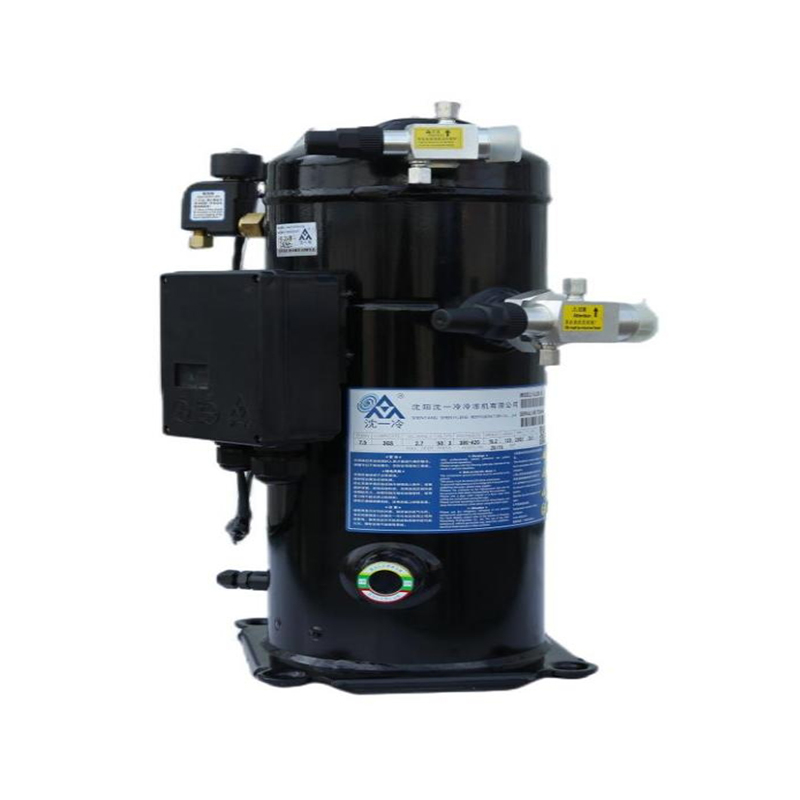 Scroll Compressor for Quiet Refrigeration CompressionExplore orbiting and fixed scroll mechanics, tight machining tolerances, low-noise operation, and suitability for hospitals, libraries, and refrigeration compression duties.View Product →
Screw: rotors and a slide valve across a wide range
A screw compressor meshes a male and a female rotor. Gas enters at one end and is squeezed as the interlobe volume closes along the rotor length. Because the process is continuous, a screw compressor moves a very large refrigerant volume from a compact frame. Capacity is trimmed with a slide valve, hydraulically or electronically positioned, and increasingly combined with a variable frequency drive. Screw machines tolerate high compression ratios, which makes them the natural choice for low-temperature duty and for chilled-water plants above several hundred kilowatts.
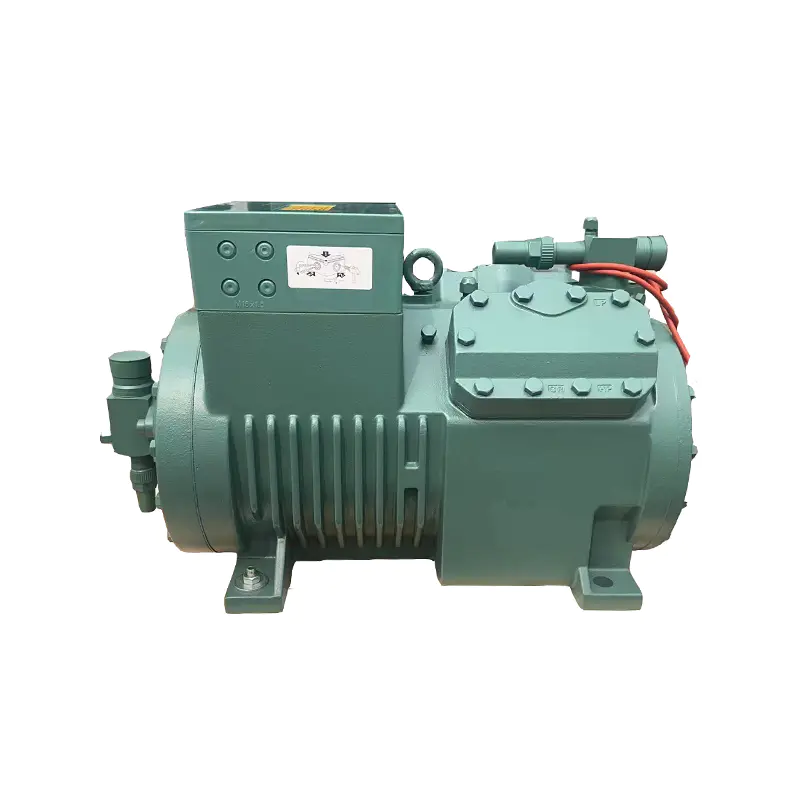 Screw Compressor with Male and Female RotorsReview opposed male and female rotor mechanics, oil-film or synchronization-gear drive, and how rotor length and diameter determine exhaust volume and pressure.View Product →
Capacity, Part-Load Efficiency and Where the Crossover Sits
A single scroll compressor covers roughly 3 kW to 30 kW of cooling, so scroll chillers scale by adding compressors in tandem, trio or quartet arrangements. Packaged scroll chillers commonly reach 300 kW to 700 kW. Screw compressors start near 150 kW and run past 3,000 kW in a single machine. In practice, the decision line sits between 500 kW and 800 kW of required capacity.
Part-load behaviour matters more than nameplate efficiency, because most chillers spend their life below full load. A screw chiller with a slide valve and a VFD holds a flat efficiency curve from about 40% to 80% load, which suits plants that follow a daily production cycle. A scroll chiller with four to six compressors steps capacity in discrete stages. Efficiency is excellent while the stages are matched, but at very low load the compressors short-cycle and efficiency falls away. If your minimum load drops below 20% of design, ask for a screw machine with VFD, a hot-gas bypass arrangement, or a thermal storage buffer.
Condenser choice changes the answer too. Air-cooled units in a 43 degrees Celsius ambient push condensing pressure up and penalise both technologies. Water-cooled shell-and-tube condensers or evaporative systems restore the gap. Floating condensing pressure control and variable condenser fans can recover 10% to 20% of compressor power in cool weather, and that benefit scales with machine size, which quietly favours screw chillers in larger plants.
Where Each Chiller Earns Its Place
Cold storage and food processing
Small and mid-sized cold rooms and blast freezers typically use several scroll compressors, because the load is intermittent and the machine must restart quickly. Central cold storage networks above 500 kW usually move to screw machines paired with low-temperature evaporators, where the compressor runs long hours at a stable suction pressure. Because low-temperature circuits fail more often than the chiller itself, it pays to study the common failure modes early. This fault analysis of cold storage refrigeration systems is a useful checklist before you commit to a compressor type.
Industrial process cooling and chilled-water plants
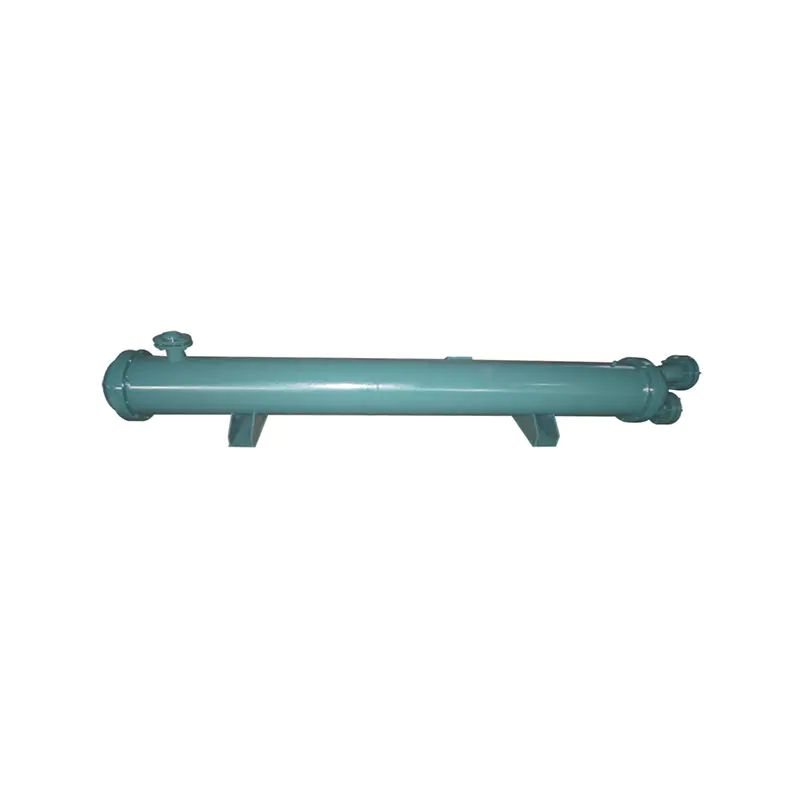
Injection moulding, dairy, breweries and chemical process lines all need a stable chilled-water supply. Where the load is large and continuous, a water-cooled screw chiller paired with a matching condensing unit and shell-and-tube condenser is the conventional answer, and the combination holds up in high ambient humidity without heavy derating.
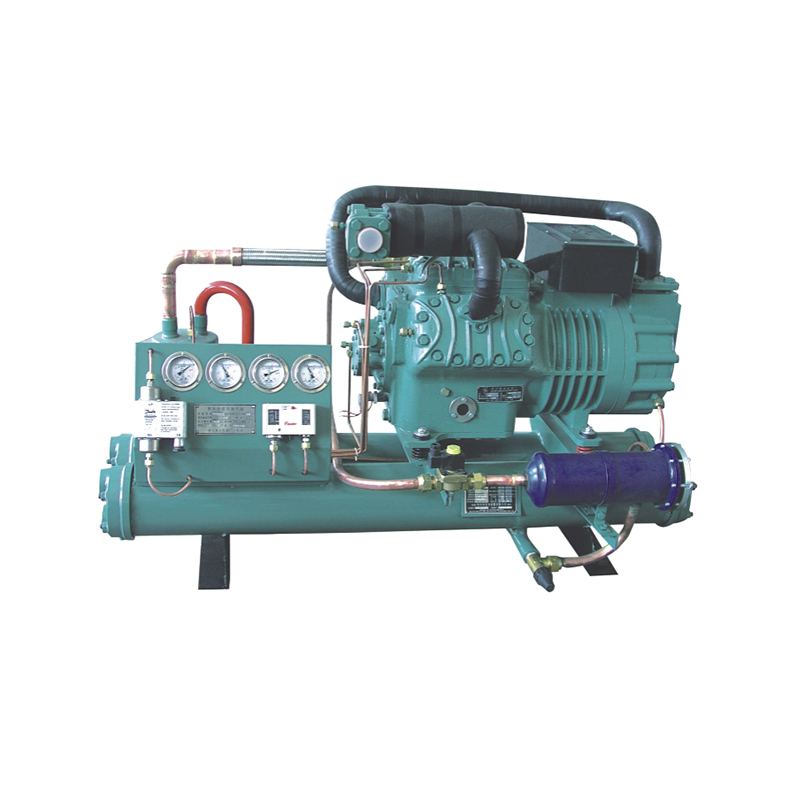 Water-Cooled Condensing Unit for Refrigeration SystemsSee shell-and-tube or sleeve condenser options, water-based cooling, and guidance on efficiency, intelligent control, refrigerant selection, and waste heat recovery.View Product →
Retrofits and phased projects
Modular scroll chillers are easier to place on an existing roof, weigh less, and can be added one module at a time as a facility grows. Screw chillers need structural review, larger pipework and more plant room space, but they reduce the number of machines to maintain once the load justifies them.
Cost, Maintenance and Lifetime Ownership
- First cost: scroll chillers are generally cheaper per kW up to about 500 kW; above that, screw machines become competitive and then cheaper per kW.
- Energy: screw chillers with VFD usually win on annual kWh above roughly 700 kW, especially with 4,000 or more running hours per year.
- Maintenance: scroll compressors have fewer moving parts and no slide valve, so service is mostly oil, filters and contactors. Screw machines need oil analysis, slide valve inspection and rotor clearance checks, so budget a higher annual service figure.
- Downtime: a scroll chiller with four compressors still delivers about 75% capacity if one fails. A single screw compressor stops the whole machine, so critical plants often specify two smaller screws instead of one large one.
- Refrigerant charge: screw chillers generally carry a larger charge, which matters under leak-tightness rules and where a refrigerant levy applies.
A rule that survives tender comparisons: compare ten-year total cost, not purchase price. Add energy at your real load profile, add service contracts, add the cost of one unplanned shutdown in your production calendar, then compare.
Selection Mistakes That Show Up Two Years Later
- Sizing on peak load only, then discovering the plant never runs above 45% of design capacity.
- Buying a scroll chiller for a 900 kW continuous process load because the purchase price looked lower.
- Ignoring condensing pressure and ambient design temperature, then losing capacity in the hottest month.
- Forgetting starting current, transformer capacity and cable sizing when replacing one large screw with several scroll compressors.
- Ordering spares and planning service access after commissioning rather than during selection.
FAQ: Screw Chiller vs Scroll Chiller
Which is more energy efficient, a screw or a scroll chiller?
At full load the two are close. A screw chiller with a VFD wins above roughly 700 kW and at part load on long running hours; a scroll chiller wins at small capacity and on intermittent duty, where quick restart and low standby losses matter more than the efficiency curve.
Can a scroll chiller handle low-temperature duty?
Yes, with a suitable evaporator and refrigerant. Small and mid-sized low-temperature rooms run happily on scroll machines. Once the load passes a few hundred kilowatts, a screw chiller with a high compression ratio becomes the more economical choice.
How many compressors should a scroll chiller have?
Four to six is the usual sweet spot. It gives staged capacity, enough redundancy to lose one compressor without losing the plant, and a control sequence that stays manageable for the site team.
Where exactly does the crossover point fall?
Between 500 kW and 800 kW for most projects. Confirm it with three numbers: peak load, minimum load and annual running hours. Those three decide the answer more than any catalogue table.
Write down the load profile before you compare compressors. If the peak is under 500 kW, the minimum stays above 30% of design, and the machine runs fewer than 3,000 hours a year, a scroll chiller will usually be the calmer, cheaper decision. If the peak is above 700 kW, the plant runs long shifts, or the duty includes low-temperature circuits, a screw chiller with a VFD and a properly sized condenser will pay back the difference in first cost within a few years.
Then match the compressor to the rest of the loop: condenser type, evaporator temperature band, controls and spare parts availability. The compressor is one decision; the system around it decides whether the decision holds up.