 English
 русский
 Tiếng Việt
Content
- 1 Storage Capacity First: The Tonnage Formula
- 2 Cooling Load: The Formulas Behind the Kilowatts
- 3 Worked Example: A 280 m³ Frozen Store at -18 °C
- 4 Why Setpoint Temperature Moves the Numbers So Much
- 5 From Kilowatts to Hardware: Matching Evaporators, Condensing Units and Compressors
- 6 Five Calculation Mistakes That Cost Money Later
- 7 Frequently Asked Questions
Two buyers can ask for "a 300-ton cold room" and mean completely different things. One cares about how many pallets the room holds; the other cares about how much heat the refrigeration plant must remove every day. In practice, cold room capacity is always two numbers: storage tonnage in tonnes and cooling load in kilowatts. Checking both formulas yourself before signing a purchase order protects you from the two most expensive mistakes in this trade — a room that never reaches temperature, and a plant that runs half empty. The sections below cover the storage tonnage formula, the heat-load formulas behind the kW figure, a worked example, and how the results translate into real equipment.
Storage Capacity First: The Tonnage Formula
The storage side of the calculation answers "how much product fits?" The formula used across the industry is simple:
Storage tonnage = internal volume × volume utilization factor × product unit weight
Internal volume is measured panel-to-panel inside the room, not from the outside drawing. A 100 mm sandwich panel takes 100 mm from every wall run, and in small rooms that error alone shifts the tonnage result noticeably. The volume utilization factor accounts for aisles, door swing clearance, air circulation space under the ceiling and around the evaporators, and the stacking method. Product unit weight is the density of the actual commodity in its packaging — cartoned frozen goods typically sit at 400–500 kg/m³, bulk frozen meat at 550–650 kg/m³, and fruit in bins at 250–350 kg/m³.
| Storage arrangement | Typical utilization factor |
|---|---|
| Loose bulk stacking, hand-loaded | 0.60–0.70 |
| Pallet racking with standard aisles | 0.40–0.50 |
| Double-deep or narrow-aisle racking | 0.50–0.60 |
| Mixed shelving and floor stacks | 0.45–0.55 |
Worked quickly: a 10 m × 8 m × 3.5 m room holds 280 m³. With cartoned frozen goods at 450 kg/m³ and a 0.5 utilization factor, capacity is 280 × 0.5 × 450 = 63,000 kg, roughly 63 tonnes. Switch to bulk stacking at 0.65 and the same shell holds about 82 tonnes — which is why layout decisions deserve as much attention as the building itself.
Cooling Load: The Formulas Behind the Kilowatts
The refrigeration side answers "how much heat must be removed?" Engineers add up four heat sources, then apply a safety factor:
Qtotal = (Qtransmission + Qproduct + Qinternal + Qinfiltration) × safety factor
Transmission load through the envelope
Q = U × A × ΔT. Here U is the overall heat transfer coefficient of the panels — about 0.23 W/m²·K for 100 mm PUR, 0.15–0.17 for 150 mm, and roughly 0.12 for 200 mm. A is the envelope surface area and ΔT is the gap between ambient and room design temperature. Multiplied by 24 and divided by 1,000, the same formula gives transmission load in kWh per day. Floors in ground contact use a smaller ΔT, since ground temperature stays near 10–16 °C.
Product load
Q = m × cp × ΔT ÷ 3,600, where m is the mass of product entering per hour and cp is specific heat — about 1.5 kJ/kg·K for frozen food and 3.2–3.8 for chilled goods. Fresh fruit and vegetables also generate respiration heat. In pure storage rooms the product load is modest; in blast freezing or busy receiving rooms it dominates, because freezing additionally carries the latent heat of fusion, around 330 kJ per kilogram of water content.
Internal loads
People (roughly 250–400 W each depending on room temperature and work intensity), lighting (LED fittings typically allow 5–10 W/m²), evaporator fan motors, door frame heaters and defrost heat all end up inside the room. Fan heat deserves respect: in a low-temperature store, fan motors alone can add 1 kW or more that runs around the clock.
Infiltration load
Every door opening swaps cold air for warm, humid air. The load depends on door size, traffic frequency and whether strip curtains or air curtains are fitted. A distribution freezer with a busy dock can carry a far higher infiltration load than an identical room opened twice a day.
Safety factor
The subtotal is multiplied by 1.1–1.3, with 1.15–1.2 common in practice, to cover pull-down after defrost, coil icing, door abuse and modest growth in turnover.
Worked Example: A 280 m³ Frozen Store at -18 °C
Take the same 10 × 8 × 3.5 m room: 150 mm PUR panels (U ~ 0.17 W/m²·K), 32 °C ambient, a 286 m² envelope, 2,000 kg of cartoned goods received daily at -10 °C, two workers for one hour, LED lighting, evaporator fans of about 1.0 kW, and moderate door traffic.
| Heat source | Basis | Load |
|---|---|---|
| Transmission | 0.17 × 286 m² × 50 K | ~2.4 kW |
| Product | 2,000 kg × 1.5 kJ/kg·K × 8 K per day | ~0.3 kW |
| Internal (people, lights, fans) | 0.8 + 0.8 + 1.0 kW installed | ~2.6 kW |
| Infiltration | Moderate door openings | ~1.5 kW |
| Subtotal | — | ~6.8 kW |
| With 15% safety factor | 6.8 × 1.15 | ~7.8 kW |
If the compressor plant is planned to run 18 hours a day instead of 24, the same daily energy must be delivered in fewer hours, pushing the duty point toward 9–10 kW. This single decision — planned running time — often explains why two quotes for the "same" room differ so much.
- Transmission — 35%
- Product — 5%
- Internal loads — 38%
- Infiltration — 22%
Share of each heat source in the example subtotal, before the safety factor.
Why Setpoint Temperature Moves the Numbers So Much
Transmission load scales directly with ΔT, so the same shell carries very different loads at different setpoints. Using the U × A of the example room, about 48.6 W/K:
Transmission load for the same room at 32 °C ambient; ΔT of 30 K, 50 K and 57 K.
Colder rooms also pay twice on the machine side: higher compression ratios reduce compressor efficiency, thicker panels raise build cost, and defrost takes a bigger share of daily energy. Freezing duty additionally carries product latent heat, so the real gap between a chill room and a -25 °C store is wider than the bars alone suggest.
From Kilowatts to Hardware: Matching Evaporators, Condensing Units and Compressors
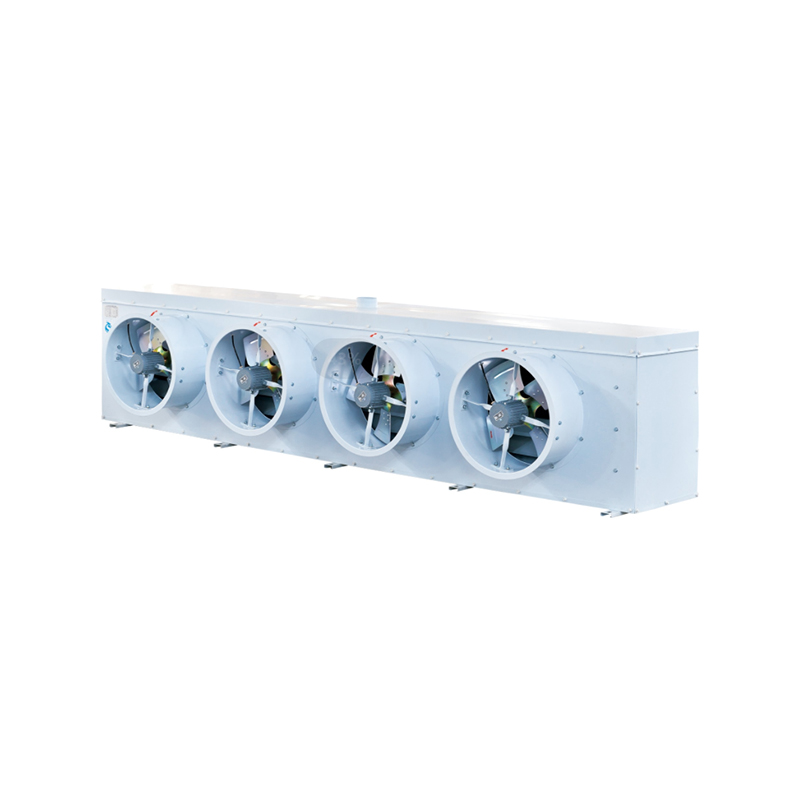
The calculated load only becomes useful when it is converted into equipment selected at the right duty conditions. Evaporators are matched to the room's temperature class: DL-series coolers serve chill and processing rooms around 0 °C, DD-series units cover medium-temperature stores, and DJ-series units are built for -18 °C and below, with wider fin spacing to cope with frost. Each evaporator is then sized at a design temperature difference of roughly 6–10 K between room air and evaporating temperature — halving the TD roughly doubles the required coil surface, a common source of under-specified quotations.
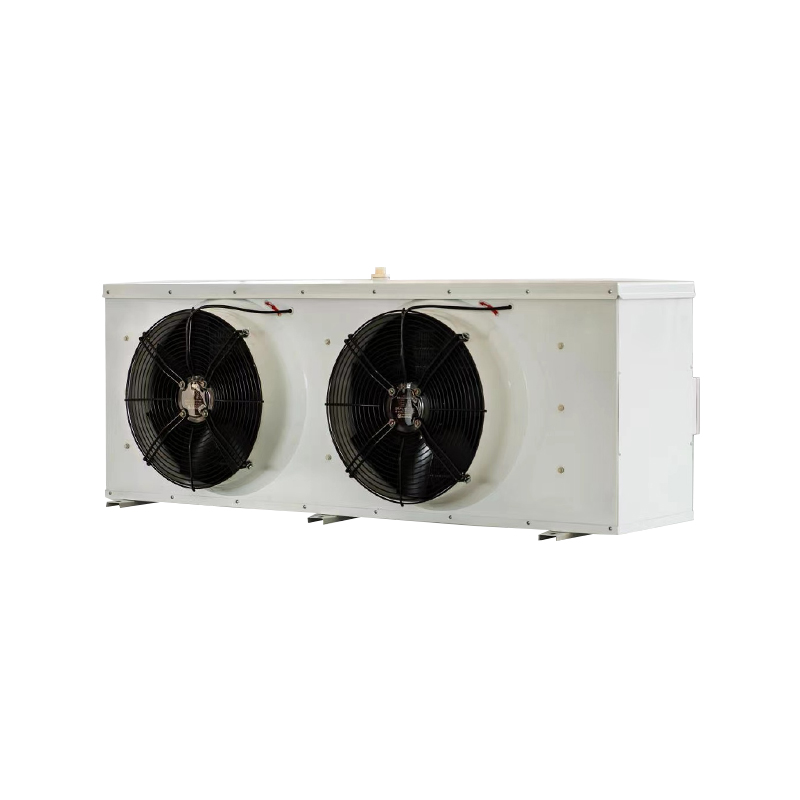 DL Type High-Temperature Evaporator for Chill RoomsDesigned for fresh-keeping cold rooms around 0 °C, the DL series suits storage of eggs and vegetables. It matches the chill-room duty discussed here, provided the coil surface is sized at the correct design temperature difference.View Product →
 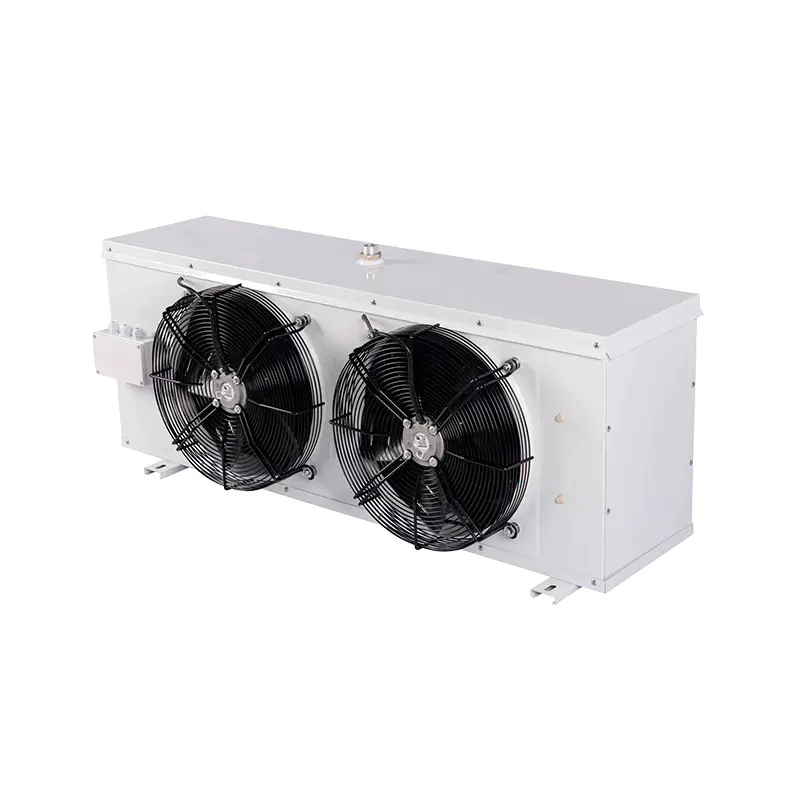 DJ Type Low-Temperature Evaporator for Freezer StorageBuilt for quick-freezing and low-temperature stores below -25 °C, holding meat, fish, frozen foods and other goods. Wider fin spacing helps cope with frost, addressing the freezer duty conditions outlined in this section.View Product →
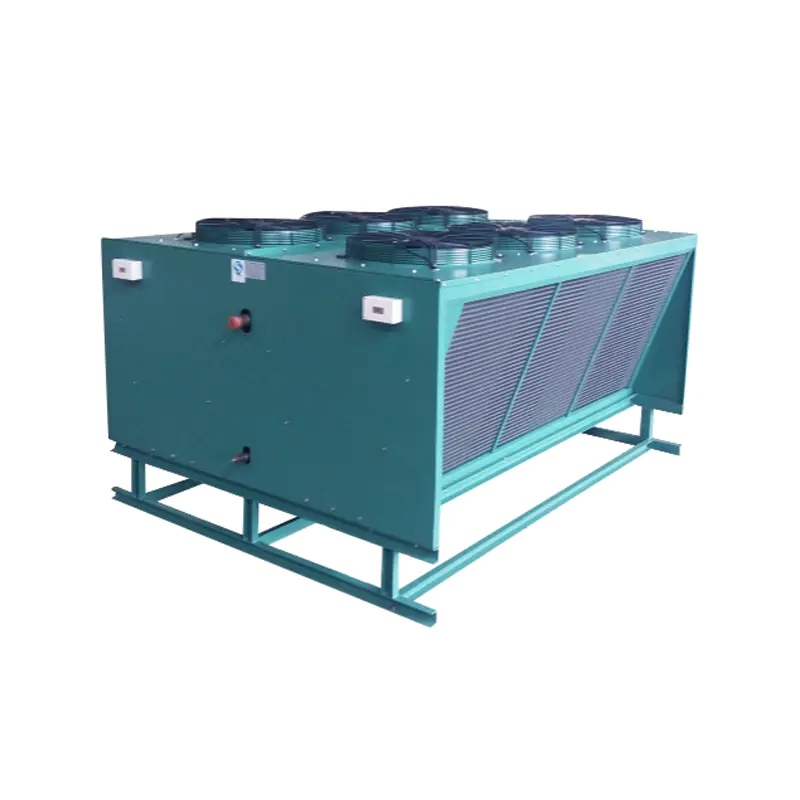
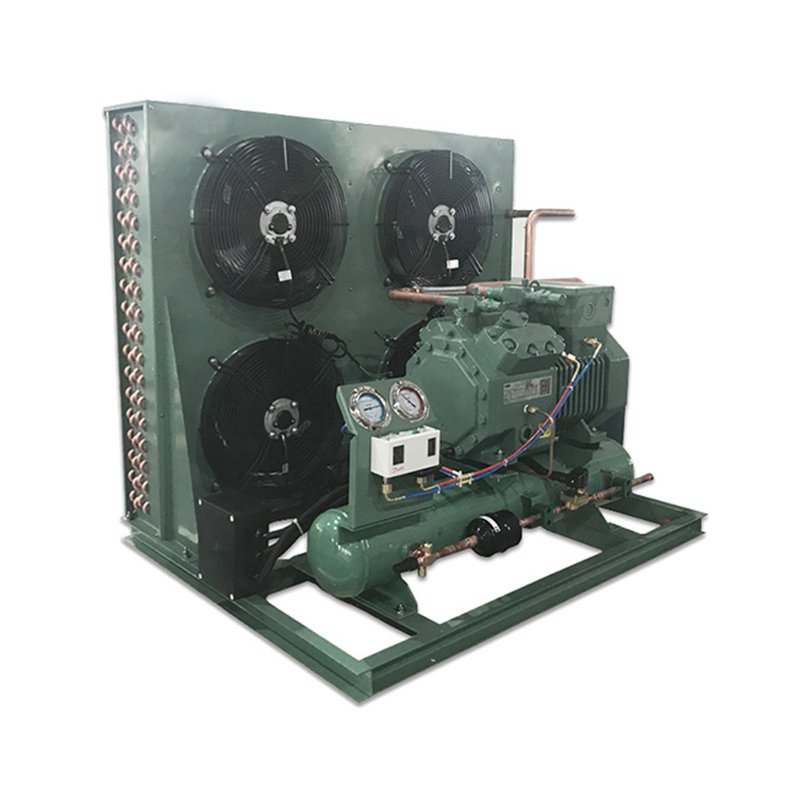
On the machine side, a condensing unit must be read at its capacity for the actual evaporating and condensing temperatures, not from nameplate horsepower. A "5 HP" unit may deliver 8 kW at medium temperature and barely 4 kW at -25 °C evaporating. Box-type condensing units suit compact cold rooms where installation space and wiring time are limited; open-type and parallel units take over as load and redundancy requirements grow.
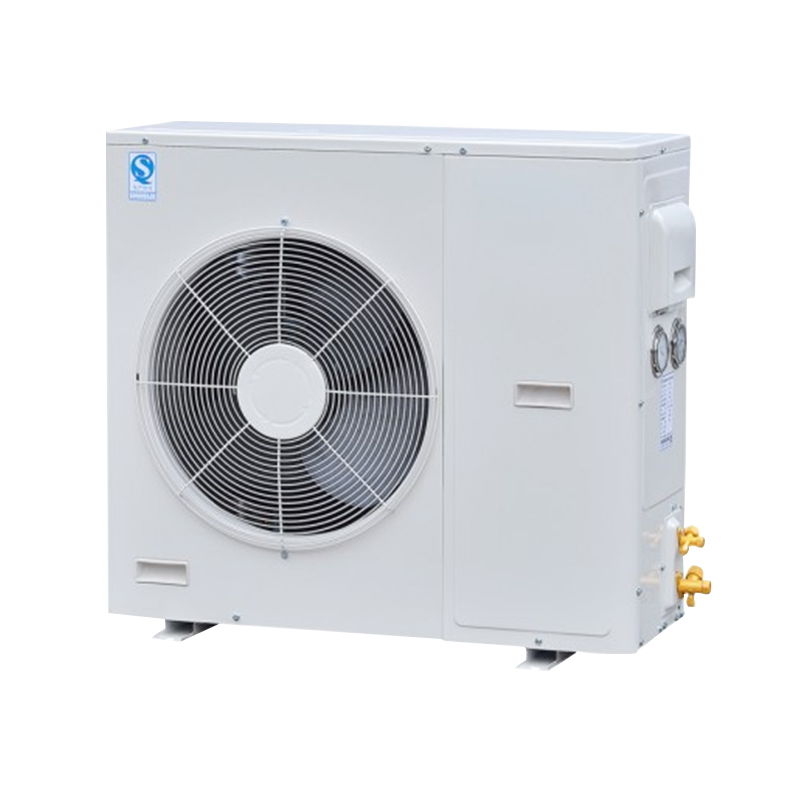 Box-Type Condensing Unit for Compact Cold RoomsThis unit seals the compressor and condenser in one enclosure, fitting small spaces with quick installation. Capacity must be read at actual evaporating and condensing temperatures rather than nameplate horsepower when selecting it.View Product →
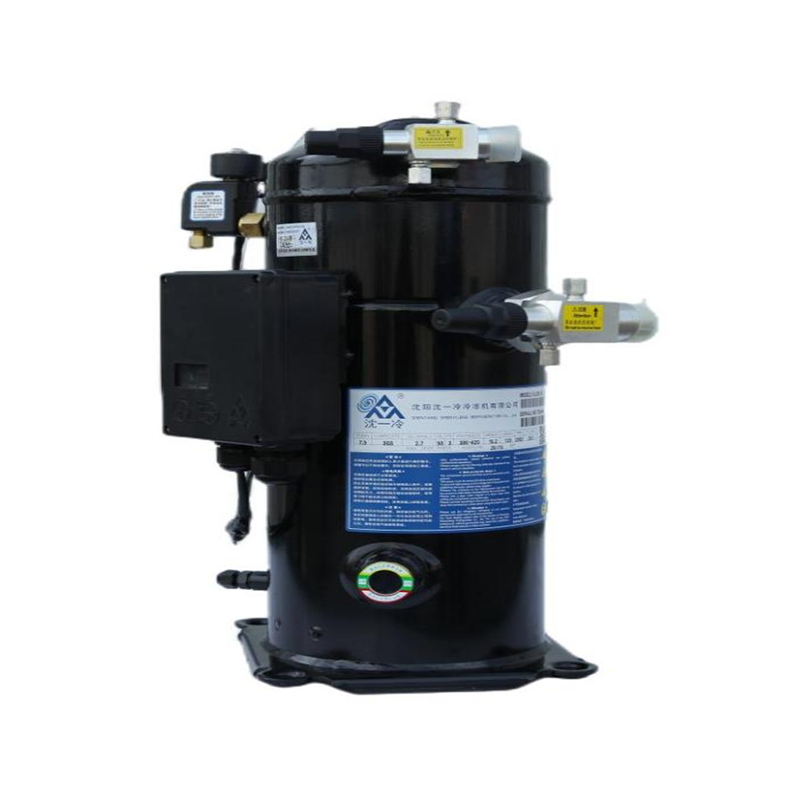
Half-enclosed and scroll compressors are then selected from the same duty point, with the safety factor already built into the load providing the margin. When a mismatched system starts short-cycling, losing temperature in humid weather or tripping on high pressure, the root cause is very often this sizing step — the typical symptoms and fixes are covered in our guide to cold storage refrigeration system fault analysis.
Five Calculation Mistakes That Cost Money Later
- Measuring external dimensions. Panel thickness quietly removes volume from every wall, ceiling and floor, and the error compounds in small rooms.
- Selecting machinery from nameplate horsepower instead of capacity at the real evaporating and condensing temperatures.
- Underestimating door traffic. In a busy distribution freezer, infiltration can exceed transmission load, and strip or air curtains change the math.
- Forgetting fan heat, defrost and door heaters in low-temperature rooms, all of which run around the clock.
- Applying an oversized "just in case" factor of 30–50%. The result is an oversized compressor that short-cycles, struggles with humidity control and burns more energy than an accurately sized one.
Frequently Asked Questions
How many watts of cooling do I need per cubic meter?
Quick planning figures for well-insulated rooms land near 50–80 W/m³ for chill rooms and 75–110 W/m³ for freezers, but these are sanity checks only. Door traffic and daily product turnover routinely push real loads outside that range, so treat the component-by-component calculation as the real answer.
Does a bigger safety factor make the system better?
No. Beyond roughly 1.2–1.3, extra capacity mostly buys short cycling, poor humidity control and higher electricity bills. Accuracy in the load breakdown protects you better than an inflated multiplier.
What should I send a supplier for an accurate quote?
Internal dimensions, panel type and thickness, setpoint temperature, ambient design temperature, daily product intake with entry temperature, door size and traffic, and planned compressor running hours. With those seven lines, a supplier can verify both the tonnage and the kilowatts instead of guessing from volume alone.
Run both formulas before you buy, and re-run them whenever the layout, product mix or door traffic changes. When you brief a supplier, hand over the load sheet rather than a target tonnage; manufacturers of compressors, condensing units and evaporators — such as our engineering team in Zhejiang, shipping to more than 80 countries — can size equipment precisely only when the calculation in front of them is honest.